‘1899’ Composer Ben Frost on Recording the Soundtrack Inside of a Ship - Netflix Tudum
Soundtrack
How Composer Ben Frost Conjured the ‘1899’Score in the Belly of an Actual Ship
“I’m in there with a recording of violins — there’s also some guy using an arc welder in the next cabin.”
By Tudum Staff
Nov. 30, 2022
What is the sound of your mind bending? It’s something musician, sound designer and composer Ben Frost knows well: He’s a master of perspective-altering music. The Australian-Icelandic creative has crafted sounds with experimental-leaning musicians — including Björk, mercurial aggro-rockers Swans, and contemporary classical composer Nico Muhly — and he sculpted the soundscapes for all three seasons of the otherworldly series Dark.
Frost has teamed up again with Dark creators Baran bo Odar and Jantje Friese for their latest visionary mystery, 1899.
Netflix’s Andrew Amondson recently caught up with Frost, who discussed how he recorded sounds inside an actual ship, his creative process and the musicians on the soundtrack.
What is the audience hearing and not hearing — in the score for 1899? The score for 1899 is primarily composed of three elements: There’s orchestral recordings from Krakow which is this amazing string section, the same people I worked with on Dark — the Sinfonietta Cracovia, who are an incredible orchestra. Then the Tangram Ensemble from London, who are this traditional Chinese percussion ensemble who provided a lot of the rhythm that kind of is the heart of the score. Then there’s actually quite a lot of vocal material as well. I worked with a range of different vocalists — some Greek singers who provide a lot of this really quite guttural, very sort of primal, driven performance and I worked with the vocalist Eliot Sumner on the title music. They’re the sort of three main elements.
What did you do with those recordings, and where did you take them? The story of 1899 is very much about the environment of a ship. It’s a huge character in the show. I was looking for a way to bring more of a character to that idea and sort of infect or imbue the music with that atmosphere. So it kind of dawned on me that an interesting way to approach that would be to take my own music and put it into an environment and approach it more like a field recording.
I took a lot of that material with me here — back to Iceland — and took it into the ship, or rather, various ships down here in the harbor. I got access to the inside of these fishing vessels, which are being repaired here. Reykjavík is a fishing town, so there’s no shortage of boats. So I’m taking those recordings and actually feeding them through the speaker into various parts of the ship and sort of using the music to resonate, literally resonate, the hull of the boat. Just kind of blur the lines between environmental sound and sound design and the people performing the actual music.
Music isn’t being performed but rather it’s appearing.
— Ben Frost
How did you broadcast the music into the ships? By taking elements of the music — I’m projecting them into a Bluetooth speaker and, having access to these ships, I’m going in there and using the hull of the ship almost like a reverb chamber. Which is something that… It’s not a new idea, the idea of putting music into a reverberant space and recording it back. This goes all the way back to the Beatles and Abbey Road, you know, setting up these tiled rooms that they would feed [John Lennon’s] vocals into and then re-record them.
Then taking that a lot further and blasting it into the ballast tanks of a ship, which are spaces that are literally impossible to record [in] were it not for this really unique situation, which is that these boats are being repaired. So the ballast tanks are being drained. And they’re open for a certain number of days and through negotiation, I’m able to get access to that and get in there and just come up with really unique results.
Obviously these ships are being worked on at the same time, so while I’m in there with a recording of violins, there’s also some guy drilling the wall or using an arc welder in the next cabin.
And so all that stuff starts to bleed together and it becomes this really sort of John Cage-ian atmosphere where music isn’t being performed but rather, it’s appearing.
It’s revealing itself in that moment and I’m just there to capture it.
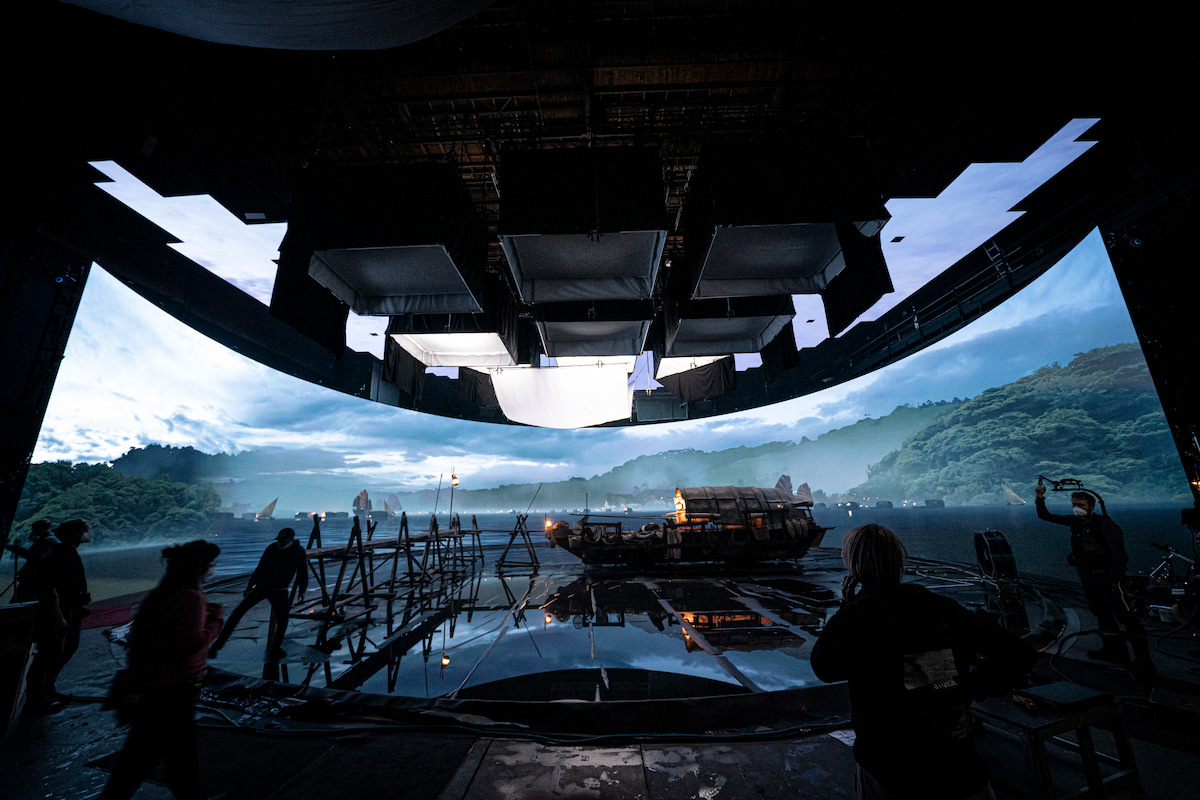
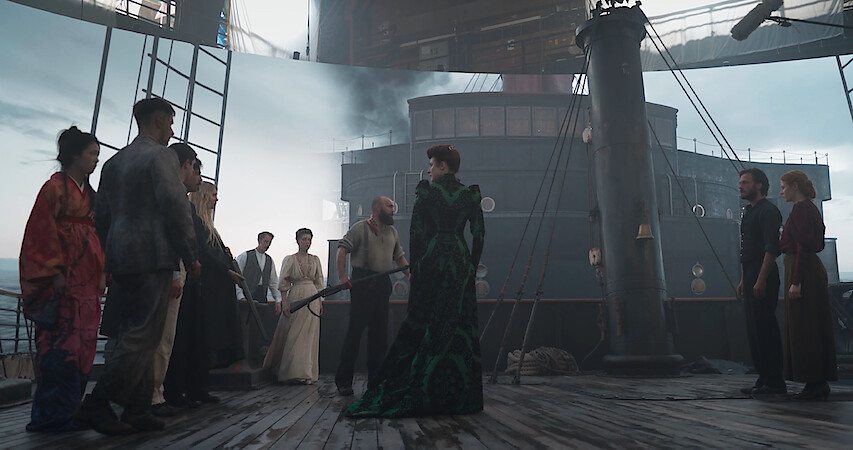
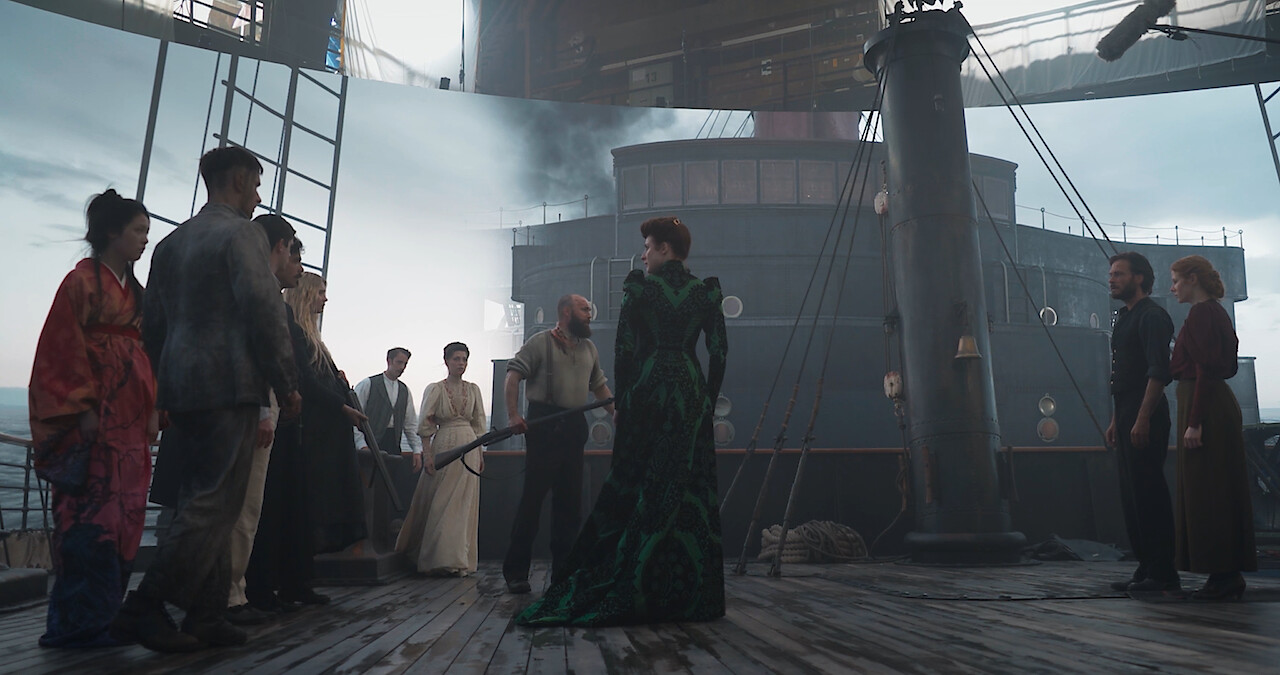
Behind the scenes of the virtual stage.
How do you see your role in this production? And how is that different from what people might think a composer does? My role as a composer for 1899 is ultimately that of being a storyteller amongst other storytellers. It’s a really complicated narrative with a lot of different threads. And some of those threads are quite clear and there’s a direct line and you’re kind of being fed information from the actors.
What that often means is I’m in the very privileged position of having this unique set of knowledge that you as the audience don’t have. And I’m feeding you secrets that don’t become fully understood until much later on, but trying to sew a kind of line through a thing so that the pieces kind of come together.
There’s a lot of other elements that are maybe not revealing themselves straightaway, and I think a big part of my job is to maybe speak the truth when other elements within the filmmaking are sort of tricking you or lying to you. Or taking you down a different path. I’m able to sort of, over the arc of the series, lay the groundwork for revealing truth.
How did you first meet [series creators] Baran bo Odar and Jantje Friese and get to know them? I first came into contact with Bo and Jantje through the first season of Dark. They called me up and asked me to come take a look at this German series that they were making that was dealing with time travel. So it had my interest. I went to Berlin and we had a discussion and I saw some footage. The first thing that really struck me was [cinematographer] Nik Summerer’s photography. The way it feels; the texture and mood of the whole thing really struck me. I could hear immediately what I wanted to do with it. So I went away and just started writing.
The creation of music exists in a dream space; it exists in a vacuum of possibility.
— Ben Frost
How did making the music for 1899 compare to the process of Dark? I took a similar approach, albeit a lot earlier in the process. Which is something I really enjoy and something that suits me really well. I’ve always seen film composition as a production role, as opposed to a post-production role. I think that that’s a fairly new invention, this idea that the composer comes in after everything’s already in the can. If you look back at the history of cinema, that wasn’t always the case. For me it is a much more meaty role to get involved early and work off the script. So along with the other heads of department, you know, while costumes are being designed and sets are being built, I’m also writing. And what that does, I think, hopefully, is creating a situation where everybody’s kind of starting in the same place. We all fan out and go off on our little adventure. And then as the thing starts to come together, all of these things have the possibility of collision.
The creation of music exists in a dream space; it exists in a vacuum of possibility.
How is creating music for films different than non-visual media? Film is a strange collaborator because film — whilst it’s incredibly inspiring to work with — it doesn’t collaborate with you. It’s an immovable object. A series of immovable objects.
So that relationship of me composing to-picture is a one-way dialogue. It’s a lonely collaboration, if you will. For me, being able to write in that dream space for longer, there’s a lot more room. It’s more freeing and the possibilities become endless. I try to stay in that zone as long as possible.
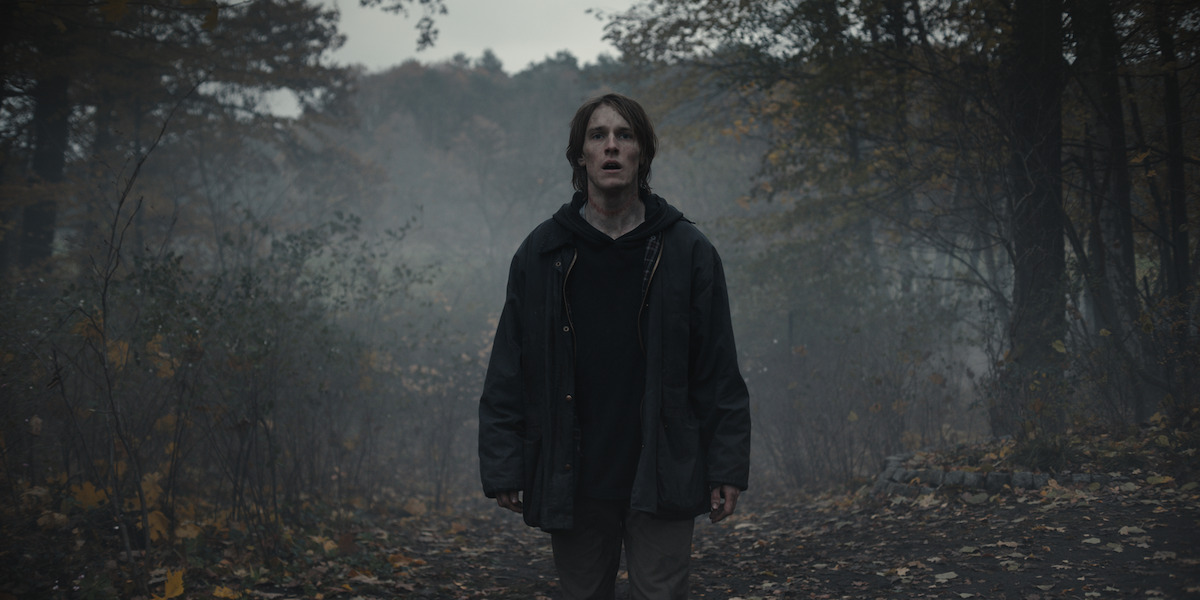
Ben Frost’s music also accompanied the series Dark.
What were the things you learned with Dark that you wanted to either do differently or take to the next level in 1899? There are a number of points of difference between the way I’m working on 1899 versus Dark. The first major difference is this environment, the literal environment of the ship, is an incredibly noisy space. If you actually think about Dark, for those who’ve seen it, it’s a very quiet film. Nik’s photography is very still. There’s not a lot of movement in the shots. The framing has a stillness to it. It’s quite painterly, almost.
1899 is very kinetic, and the environment that these characters are in, especially in the third class, is incredibly noisy. And so that changes, immediately out of the gate, the relationship between the picture and the music. It also means that a lot of the dialogue and a lot of the events that are occurring are occurring in transit. There’s a lot of movement. Physical movement. And so from very early on, the conversation between Bo and myself was about this idea of movement and percussion and rhythm.
So I really went pretty deep into that rabbit hole of just drums and lots and lots of rhythm.
How do you leave room for an audience to really find their own answers to the story and find their own way? Music is such a powerful weapon in film. And to that end, it is something I’m weirdly treading lightly with. I’m often the guy that’s in the room fighting for the absence of music because of the effect that it can actually have on an image. And often its absence is the thing that will kind of deliver the punch. And not the bigger noise.
There’s so many moments in 1899 where we’re really playing with sowing ideas that you’re maybe not even consciously aware of. And that’s something I think about a lot. Trying to find ways to tell a story that, even if you’re not picking up on it at that exact moment, when you eventually reach the kind of “da-duh!” moment, you’re going to realize that that thread — it’s been there the whole time. But it’s just been buried in such a subtle way that it’s always feeding you, but not beating you to death.