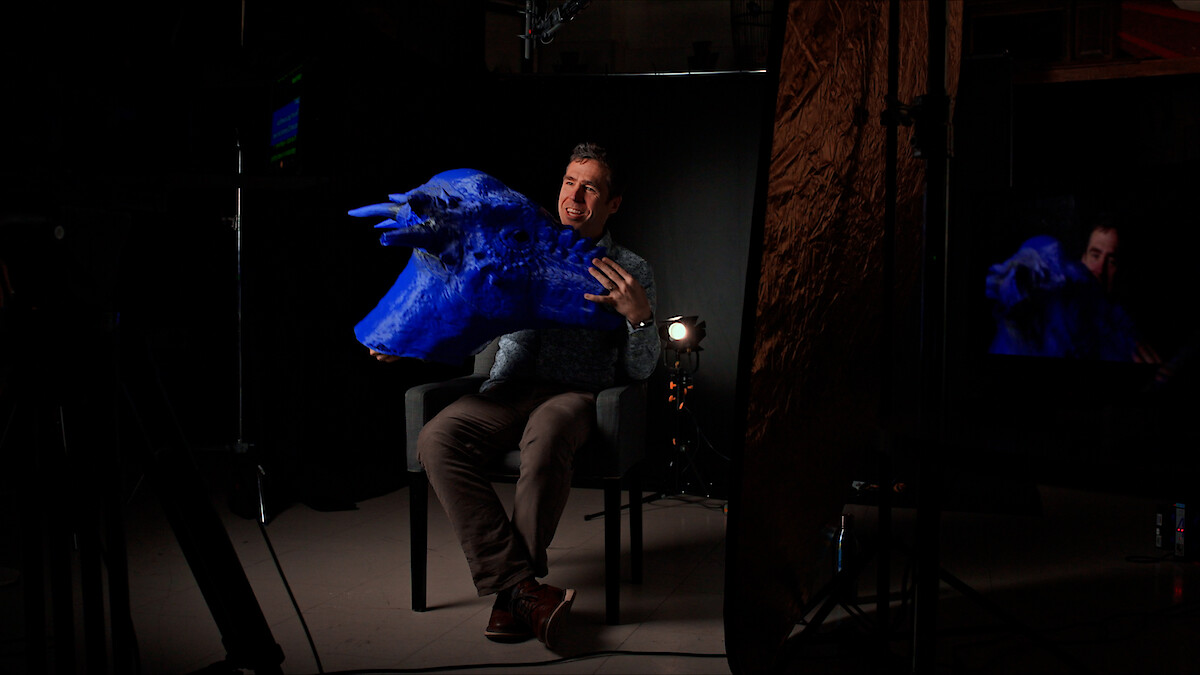
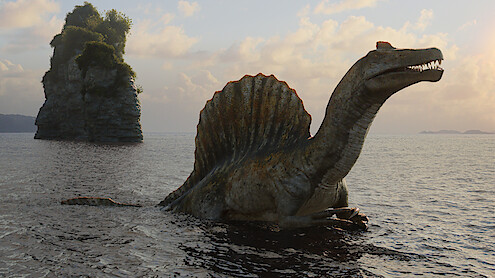
[narrator] The dinosaurs feature all sorts of dino beasts, from the iconic to the unheard-of and everything in between. But what they all have in common is that someone, somewhere had to make them come to life. But where the hell do you begin? Getting a film crew inside the ILM office is absolutely unheard of. But on this occasion, we have made an exception.
[upbeat, inspiring music plays]
[music fades] And we didn't drive to survive.
[majestic music plays]
[Jonathan] We've built over 60 creatures. As usual, there's some fantastic giant dinosaurs in the show. But great things also come in small packages, none more so than fantastic little Heterodontosaurus.
[chirps] He's a strange little dino that's full of charm.
[man] Heterodontosaurus is one of my favorite dinosaurs in episode two. He's a real cheeky chappy. He's small, and he lives in a world full of giants, but he's got some real personality.
[chirps] But to make a Heterodontosaurus, you have to start with science. I start out by liaising with all sorts of experts around the world to gather the latest information on the creature's size, shape, movement, gait, muscles, pivot point, skin color. You name it. With all that information, I write up a kind of mega document that goes to the team at ILM, who have to transfer all this information on paper into their digital animations. The people who make the models inside the computer do it as well, a bit like you would with clay. So they start with a very rough shape, and then they sculpt away bits, just like you would shave clay off a real model. You've now got a skeleton, and you've got the exterior shape of your creature. Somebody called a rigger, then actually, they attach the skeleton structure to the muscles and to the skin and define how that works. Once this walking shape exists, I jump on a call with ILM to talk about what's working and what's not working from a scientific point of view.
Should we start with Heterodontosaurus?
Yeah. It's up and running, as they say. It is, isn't it? Yeah. We just had a couple of feedback notes for this one. So the tail is probably a little bit waggly. The tail muscle is the thing that's pulling the leg back. That's producing the force. So when his leg's back there, the tail's coming this way. Yes, exactly. Okay. Actually, having some science there to rein you in and give you some boundaries helps bring a kind of instant realism. Next, what we really need to do is figure out what does he actually look like? And to do that, we have to go to the paleoartist Mark Witton.
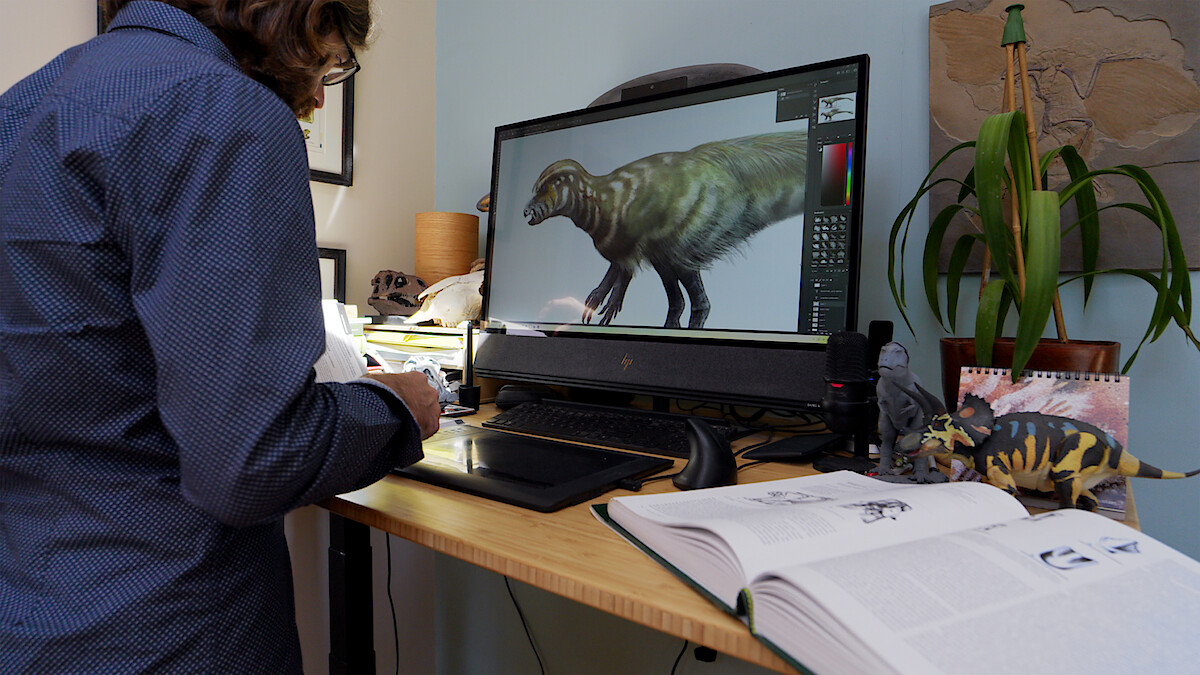
[Mark] What is a paleoartist? Well, we're someone who uses the latest science to try and restore extinct animals in the most accurate way possible. We've known about Heterodontosaurus for many decades. But typically, it was restored with scales. Nowadays, we know that that's wrong, and that Heterodontosaurus were actually covered in some sort of proto-feather type substance. This means that they probably look a lot more like a bird than they do a lizard. You've got this tiny skeleton inside this big sort of booth of fibers. But while that's really fun and interesting for me to draw as a two-dimensional artist, it's a lot more complicated for guys like ILM to deal with in 3D. A Heterodontosaurus got this beautiful plumage, which I've seen is particularly tricky to animate. Actually, it could raise and lower his spines depending on, like, "Is he curious?" "Is he going to try and shrink himself kind of down and hide a little bit?" One thing I love about Heti is his cheek pouch. It's such an unusual feature and was really fun to make. I remember when I was a kid, I had a hamster. So he used to store food all the way up here. So I kind of took that as main inspiration, but then also looked at chipmunks and other small kind of rodents to help us with that. Cheek pouches are one thing, but chipmunks something else. ILM's first cheek pouches were massive. So I had to ask for him to have some surgery and have his cheek pouches reined in to what the science demanded, which I kind of felt a little bad about, to be honest.
[majestic techno music plays] It is hundreds upon hundreds of hours to go into creating an asset like Heterodontosaurus.
[narrator] After six months of back and forth, we built the most accurate Heterodontosaurus ever seen on screen. All that was left, drop it into every shot and bring it to life.
[majestic music peaks and fades]