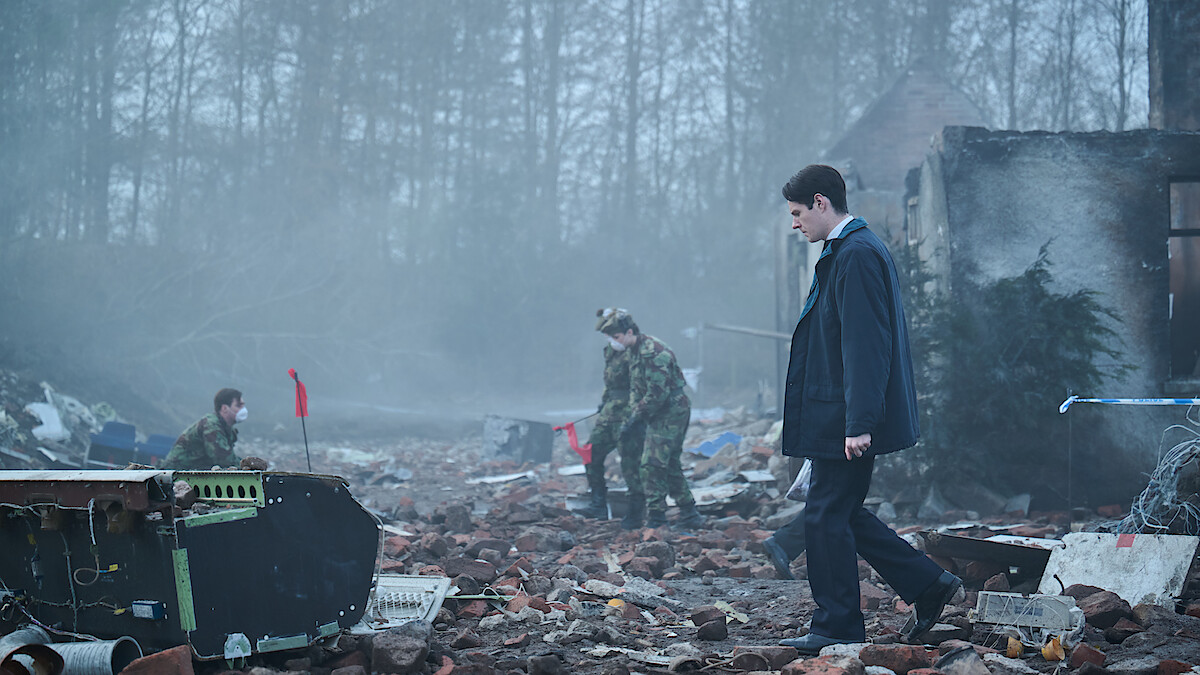
Images: Bernard Walsh/Netflix
Guide
Explore the History of Vikings: Valhalla and Its Thrilling 3 Seasons
The truth is always stranger than fiction.
July 15, 2024
While the Viking Age lasted only about 300 years, the legends of those world-spanning exploits live on forever.
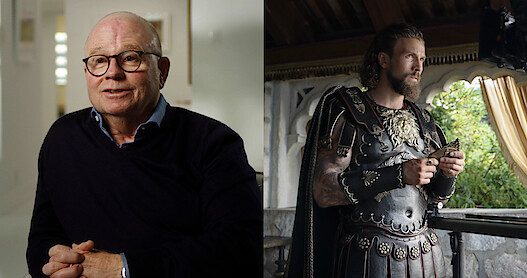
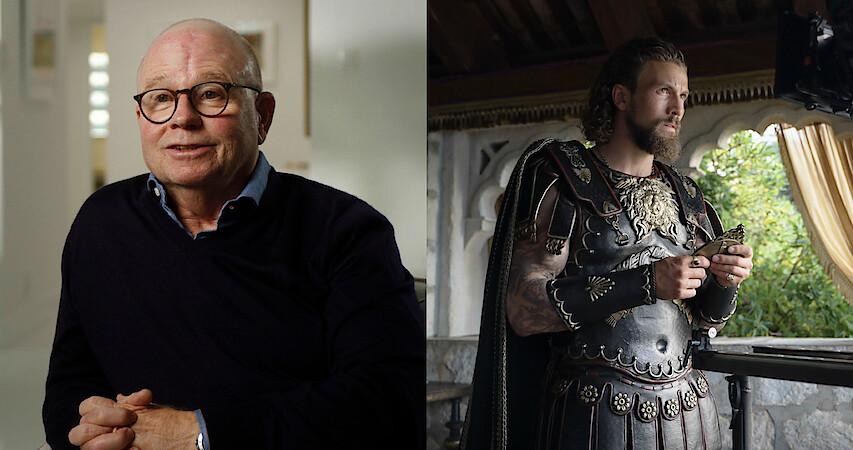
The action-packed series Vikings: Valhalla, created by Jeb Stuart, is historical fiction, but the tales of conquest, exploration, and trade find their roots in fact. “You can’t do a show like Valhalla without incredible amounts of research,” says Stuart, “and we’re learning about the Viking world literally daily through new archaeological finds.”
Our story begins more than a thousand years ago, in the early 11th century, when bloodshed was rampant. Tension between the Vikings and the English reached a boiling point, and there was additional conflict among the Vikings over pagan and Christian ideologies. The series chronicles these warriors’ exploits on and off the battlefields from the (fictional) Norwegian settlement Kattegat to England and beyond.
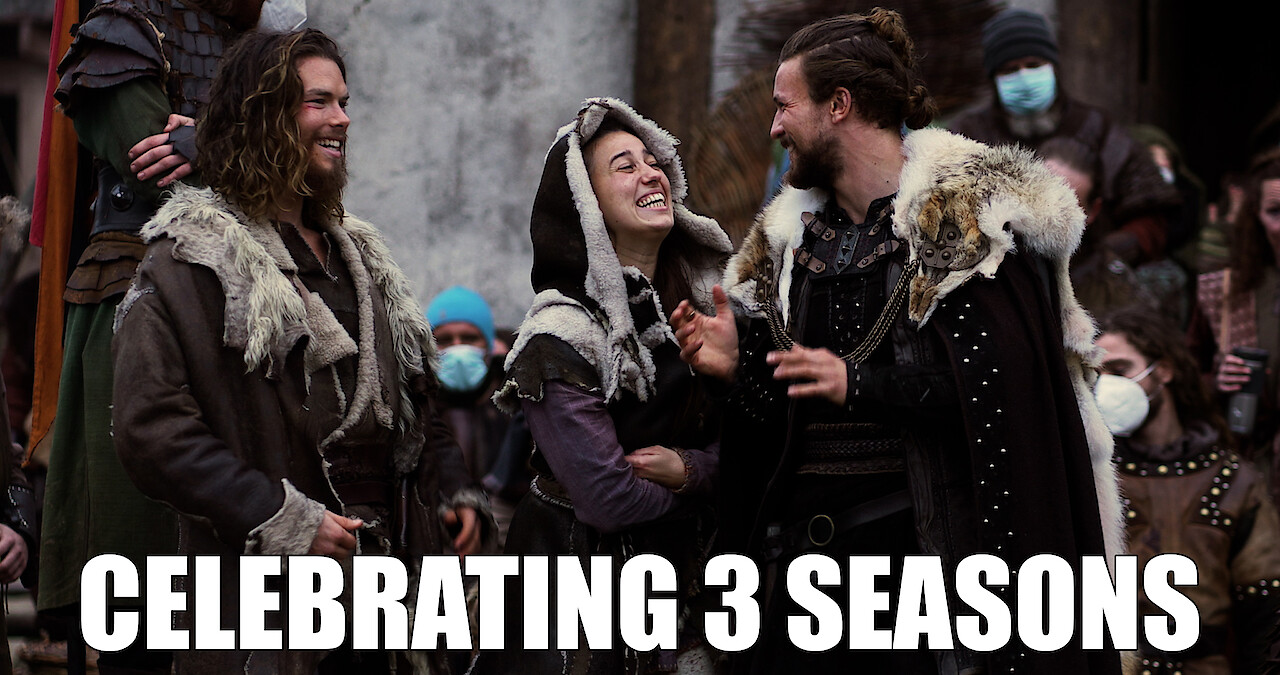
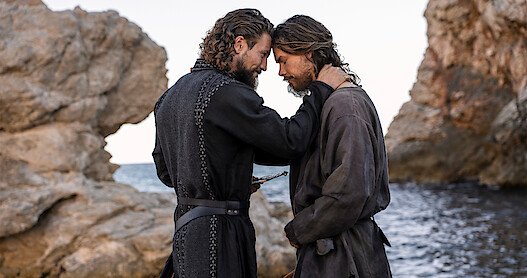
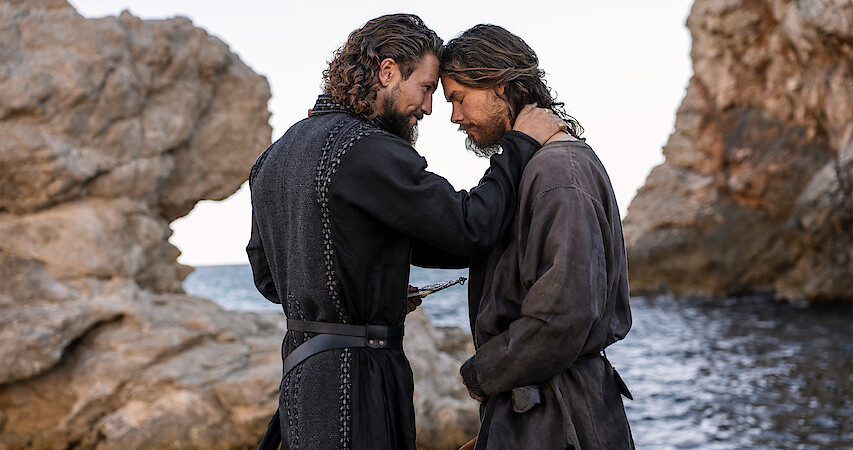
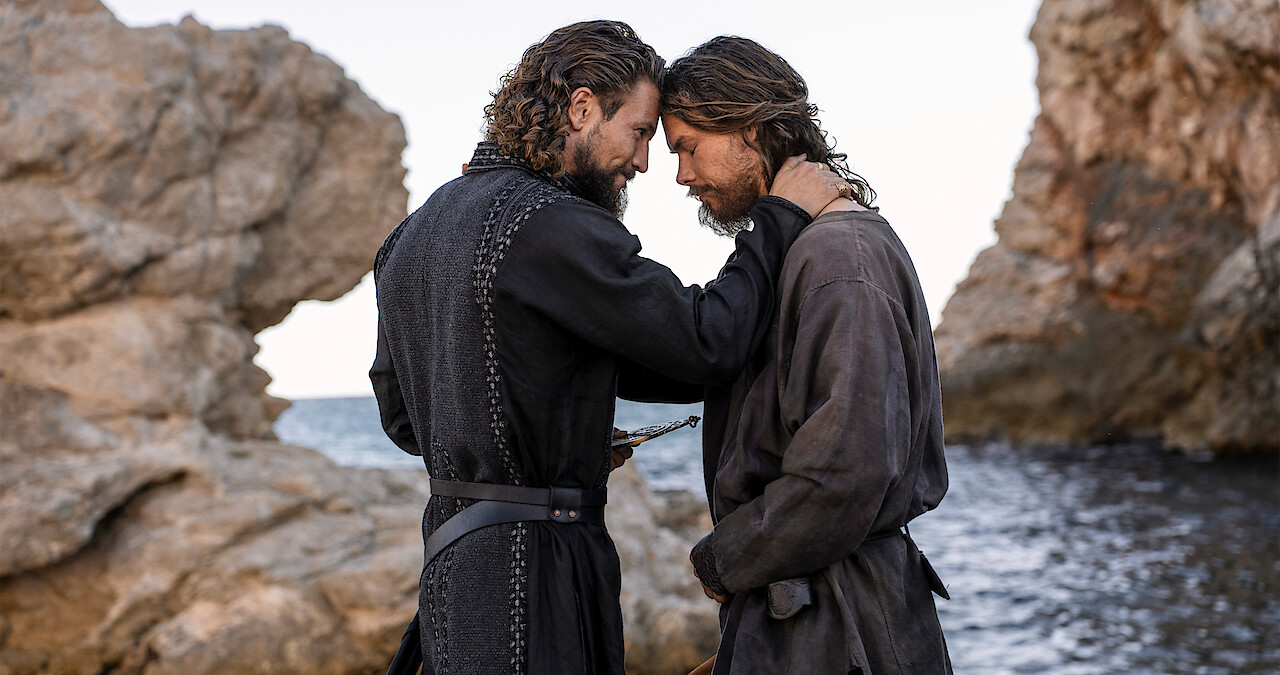
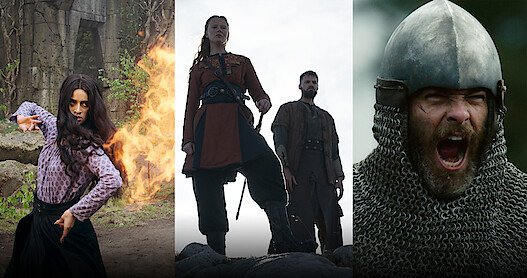
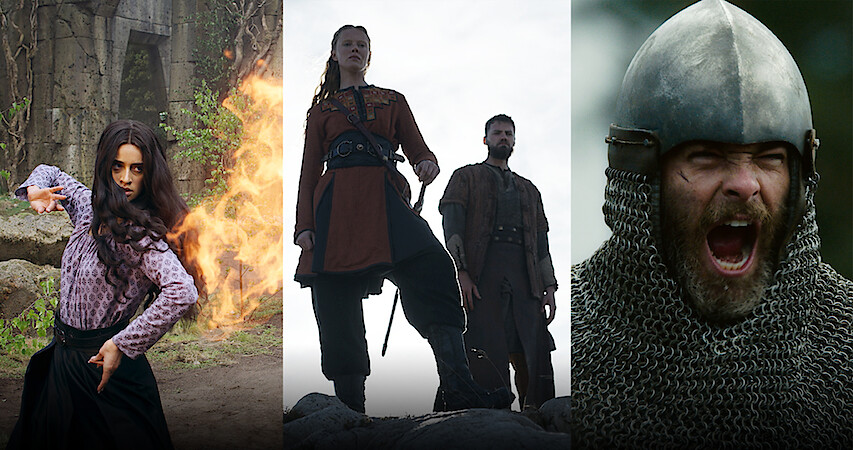
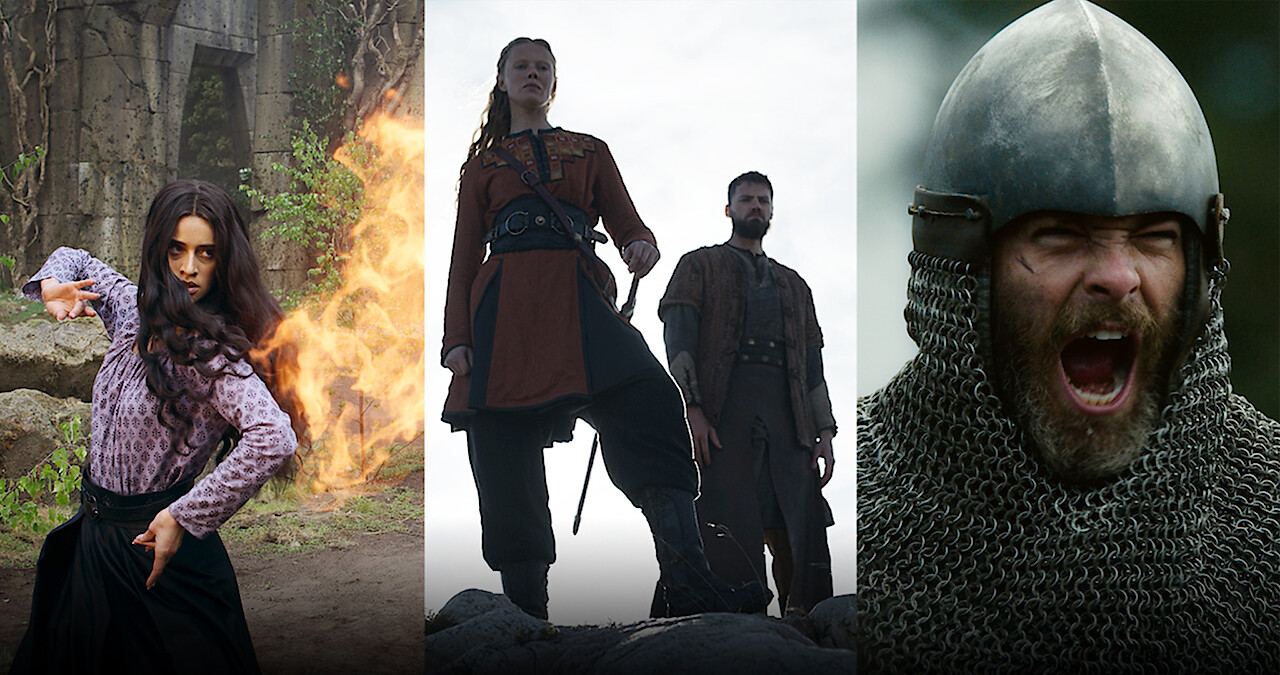
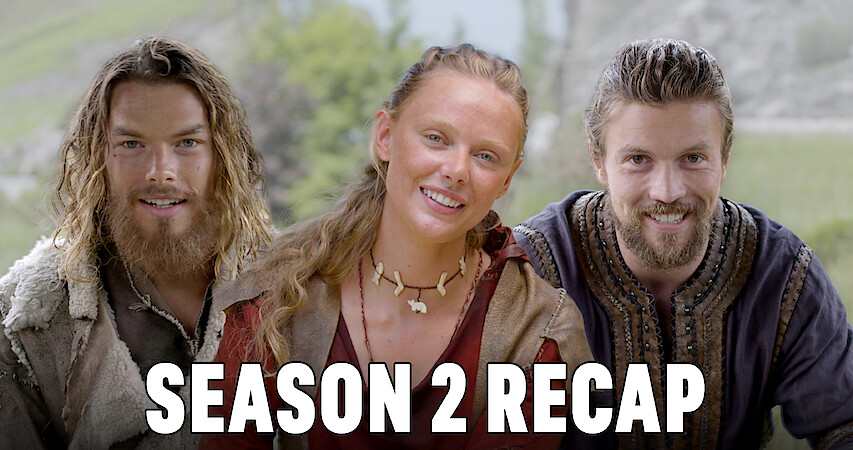
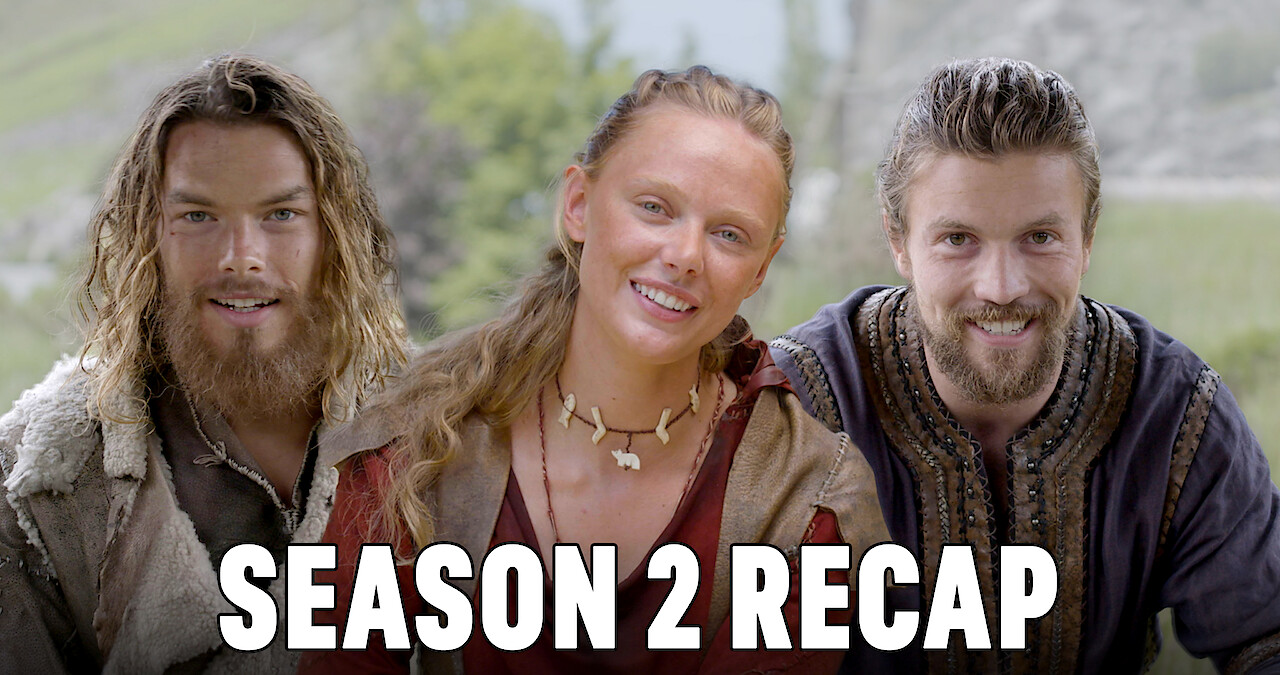
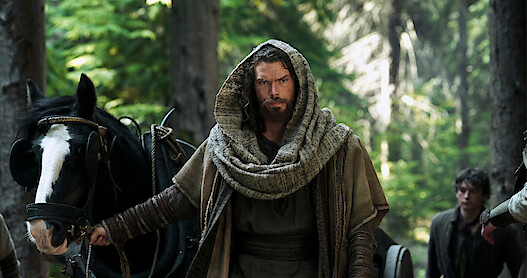
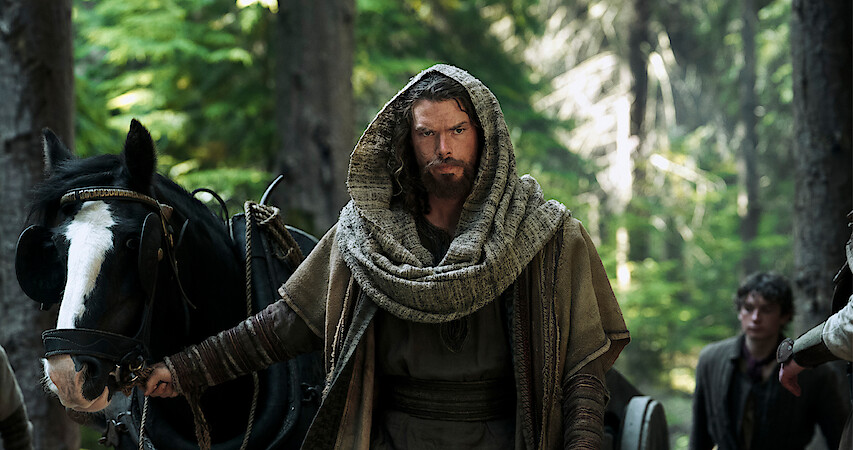
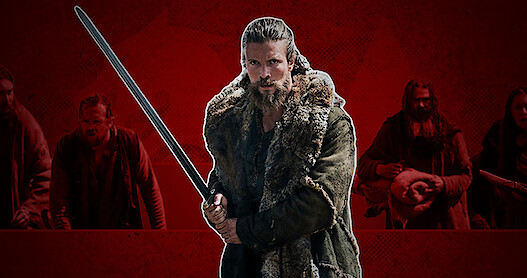
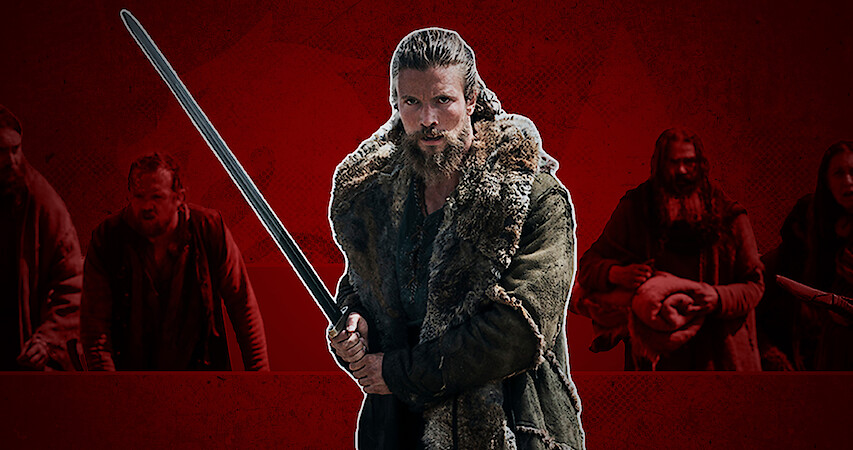
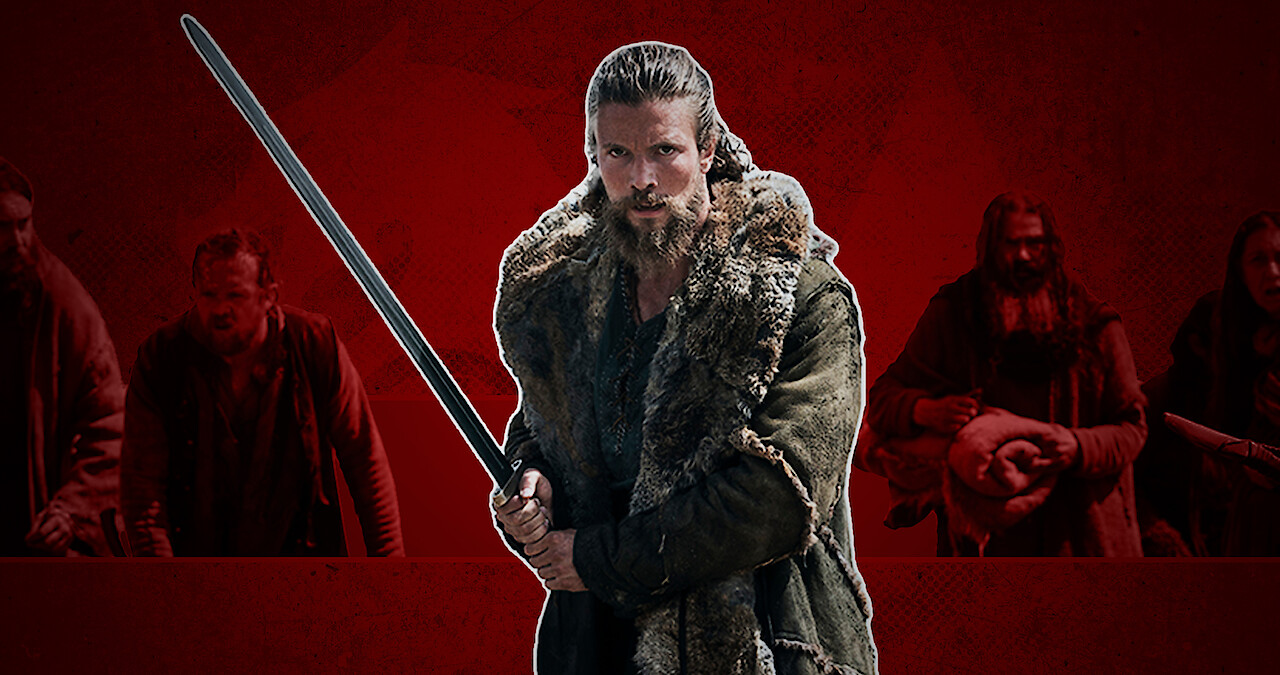
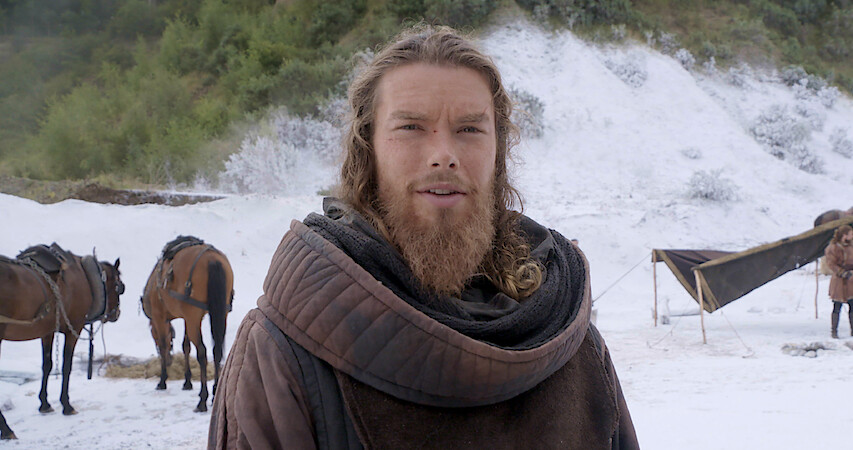
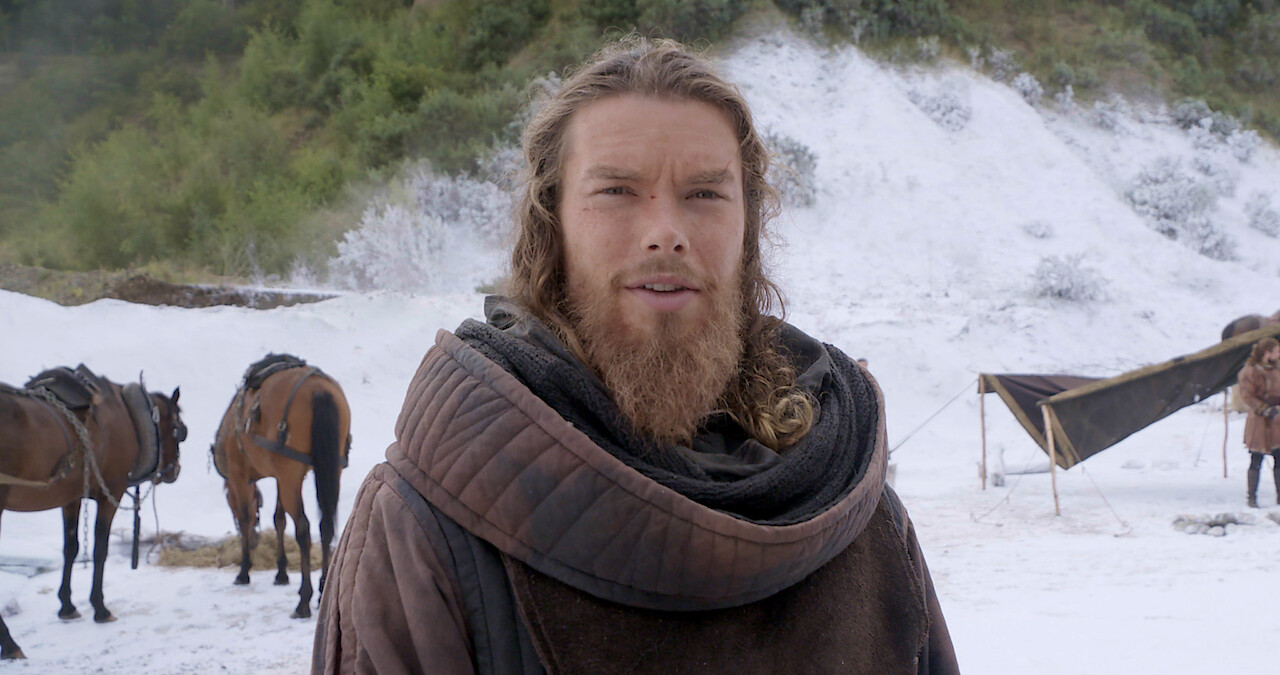
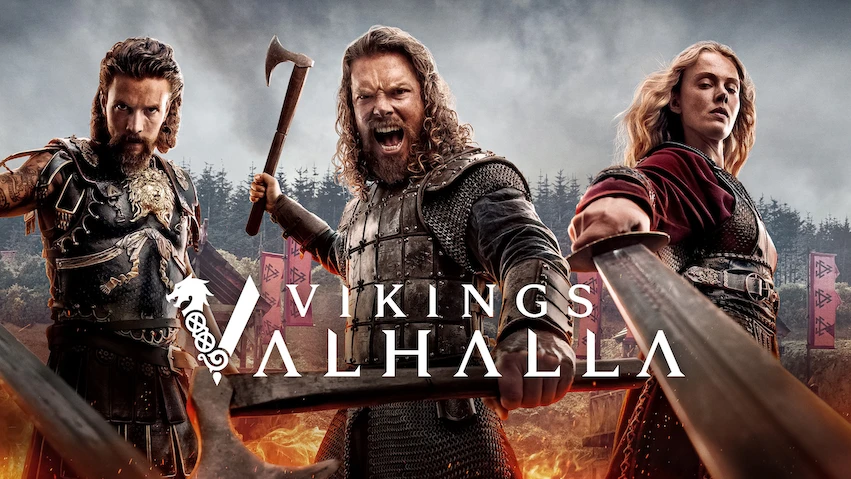
Our heroes are Leif Eriksson (Sam Corlett), the most famous Viking explorer in history; his strong-willed sister, Freydís Eiríksdóttir (Frida Gustavsson), who has her own fascinating legend; and Harald Sigurdsson (Leo Suter), the ambitious prince of Norway. By the third and final season of Vikings: Valhalla, streaming now on Netflix, the adventurers have settled in far-flung locations, from the bustling city of Constantinople to the Viking stronghold of Jomsborg.
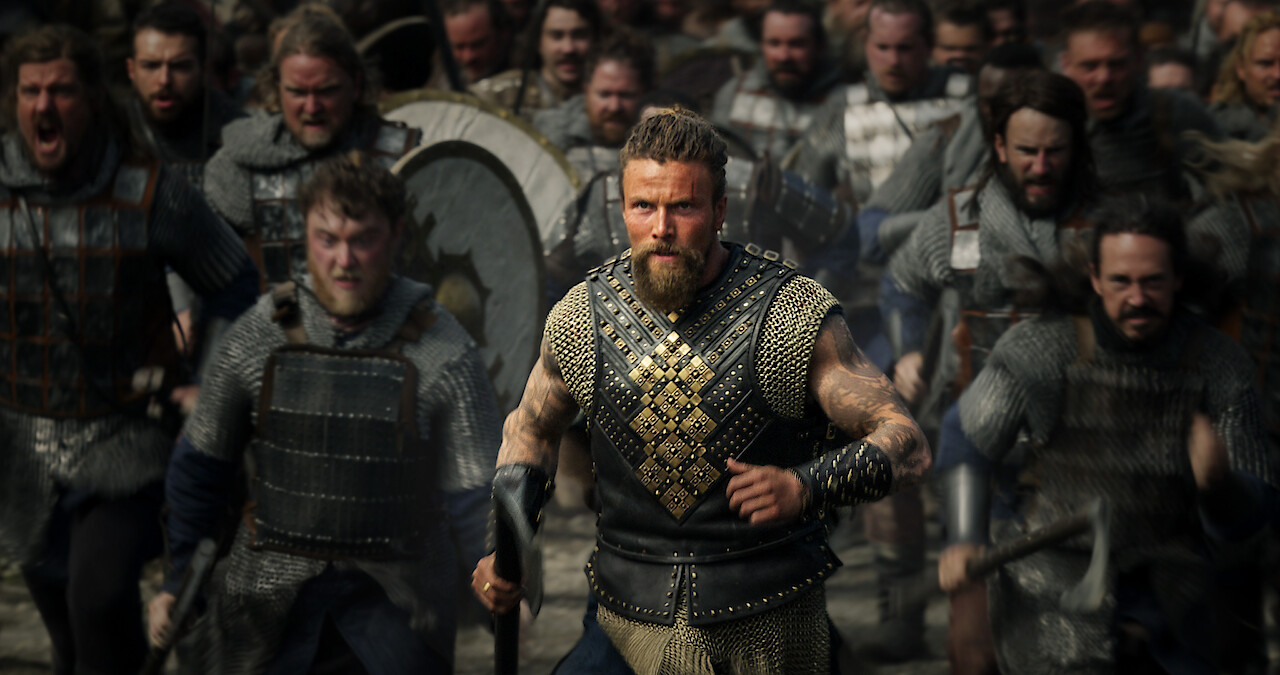
As historical fiction, plot lines and characters have been altered to make for compelling drama, but much of it is based in fact, including the minute details of costumes, sets, and weapons. The Vikings didn’t record their exploits, so much of their world is up for interpretation. But many of the events and characters in the series are real, including those that seem to be made up, like the aptly named King Forkbeard.
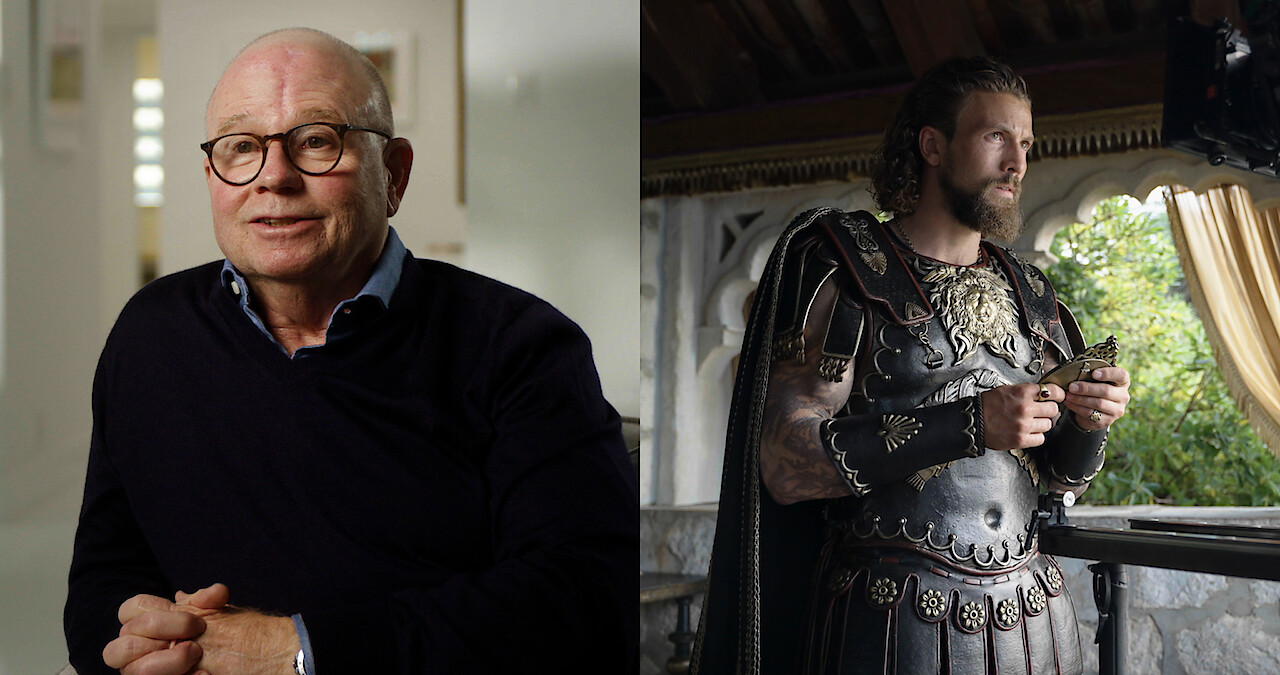
Historical consultant Justin Pollard helped craft the authentic elements of the story.
“I’ll write an outline of what actually happened, and then suggest a story, something that happened or could have happened at the time,” he says. “It’s always stranger than the stuff you could make up.”
Discover the true stories behind the axe-bashing series below, with insights from Stuart and Pollard.
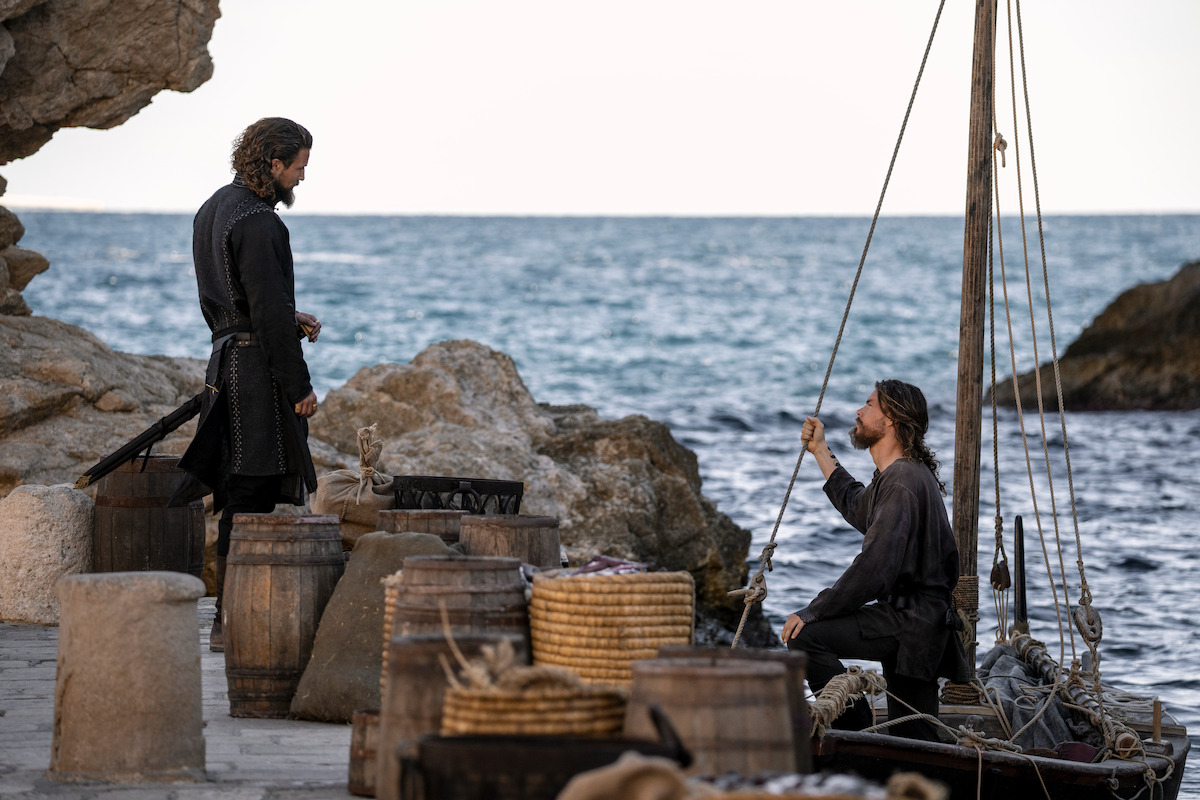
Season 3 takes place seven years after the second season, so Stuart places it around 1030 or 1033 AD. “It’s a very interesting time in the Viking [world],” says Stuart. “The Viking exploration was really at its apogee. [They] fully explored the Baltic. England, Scotland, Ireland all had Viking establishments. Iceland had a Viking establishment. Even Greenland had a Viking establishment. The Vikings also were across the Mediterranean by this time. They had been in North Africa. They had been in Sicily. They had been in Italy. They had been in Spain. It was really a point where their influence had reached its sort of peak.”
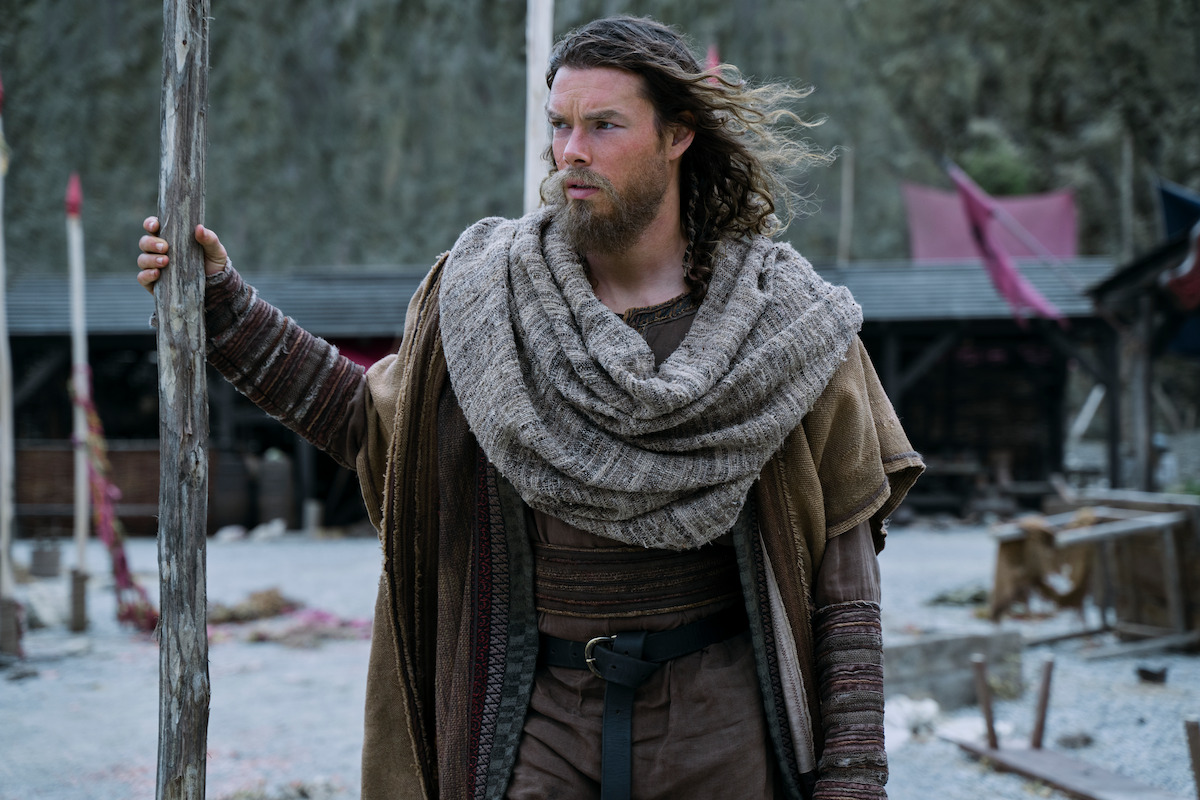
Leif and his sister Freydís were both the children of Erik the Red, who founded the first European settlement in Greenland. Leif was supposedly the first European explorer to reach North America, landing on the eastern coast of Canada. But Leif did not travel into the Mediterranean or to Constantinople as happens in Season 3. “There’s no historical evidence,” Stuart says. “But we do know that Leif was very inquisitive. We know that he did go to Norway, he did go to Iceland, Scotland. He spent some time in England.”
Pollard says we know little about the real Leif. “We know he’s a great traveler and he’s a great navigator and he’s a bold navigator because he’ll navigate open water,” he says. “For us, he represents the Viking traveler of the old age.” While Leif was a world traveler, Pollard believes he never really met Harald in real life.
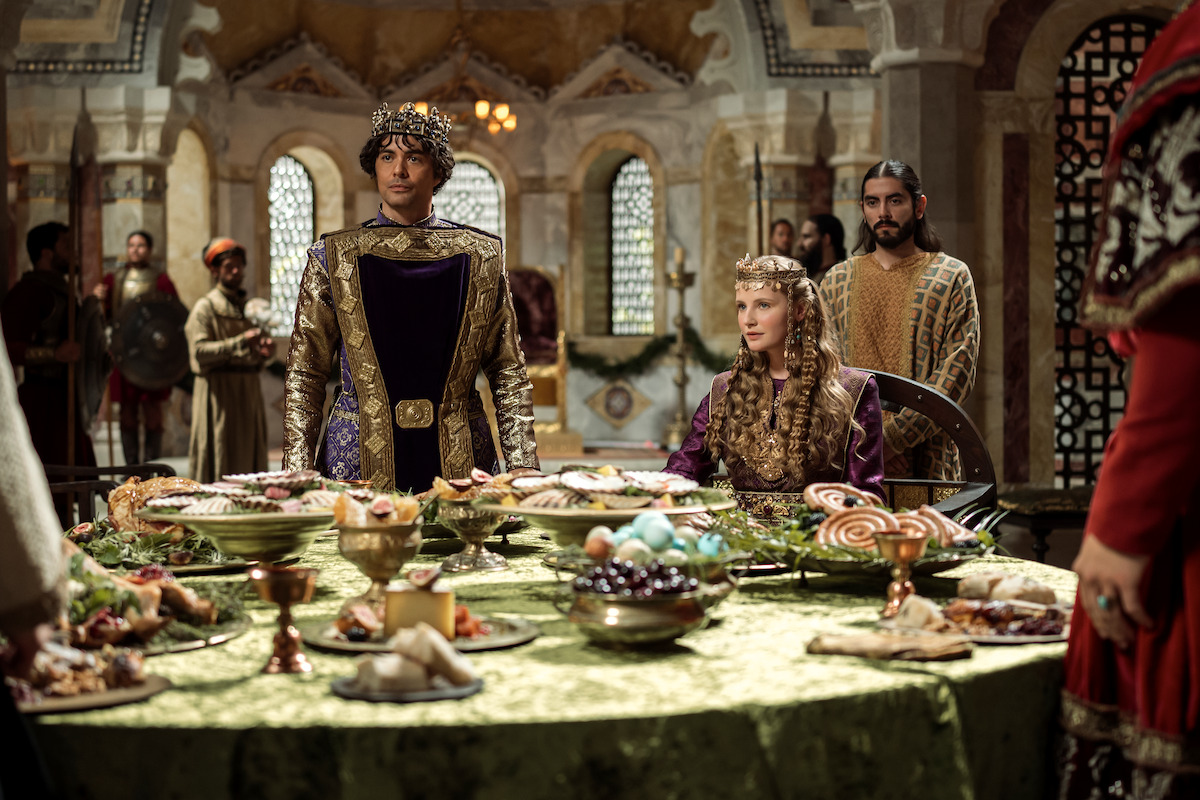
During the time period of Vikings: Valhalla, the Roman Empire had long since essentially split into two parts, says Pollard. “The Eastern Roman Empire is a bit that survived [and became what] we call the Byzantine Empire,” he says. “[It was] incredibly wealthy, Greek speaking, [and had] control over the Mediterranean.”
It was an extension of the Holy Roman Empire and lasted for more than a thousand years, says Stuart. But the empire was named long after it had collapsed. “At the time of our story, anyone within the Byzantine Empire wouldn’t have referred to themselves in that term,” says Stuart. “They would have used Roman, even though there was a much higher concentration of Greek than there would be of Latin.”
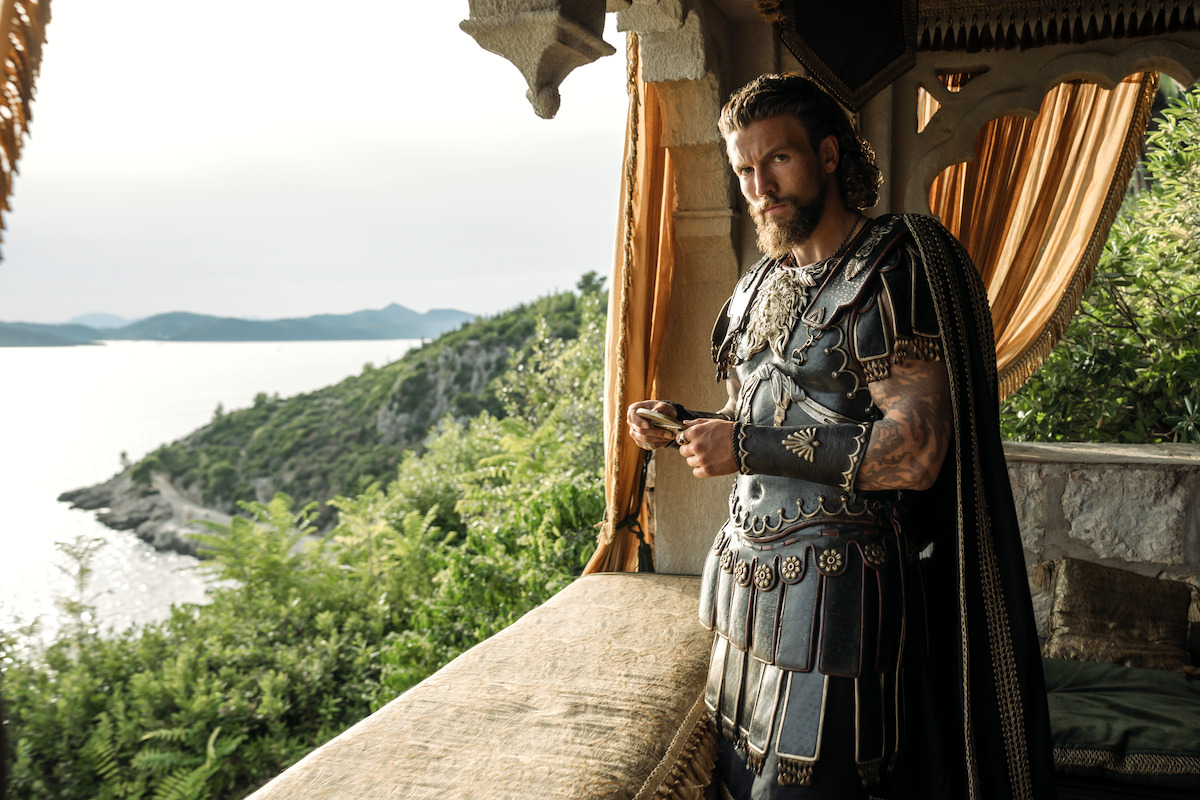
When Harald becomes the leader of the Varangian Guard, he settles into the bustling world of Constantinople, which was unlike anything he had seen in Northern Europe. “For someone brought up in the northwestern part of Europe, who would spend their lives raiding fishing villages, or possibly the odd monastery where you may get a couple of nice bits of gold off the cover of a book, Byzantium would’ve been astonishing and breathtaking,” says Pollard.
Stuart continues: “Constantinople, being the hub of the Byzantine Empire, was at the crossroads of both Asia and Europe. It was a trading hub. It was part of the Silk Road. It reached people from as far away as Vikings, and as far away as India, and perhaps even China. To put it in perspective, London in 1066, which is not too far away from our time period, had only 15,000 people in it. Constantinople had somewhere between a half a million and a million people.”
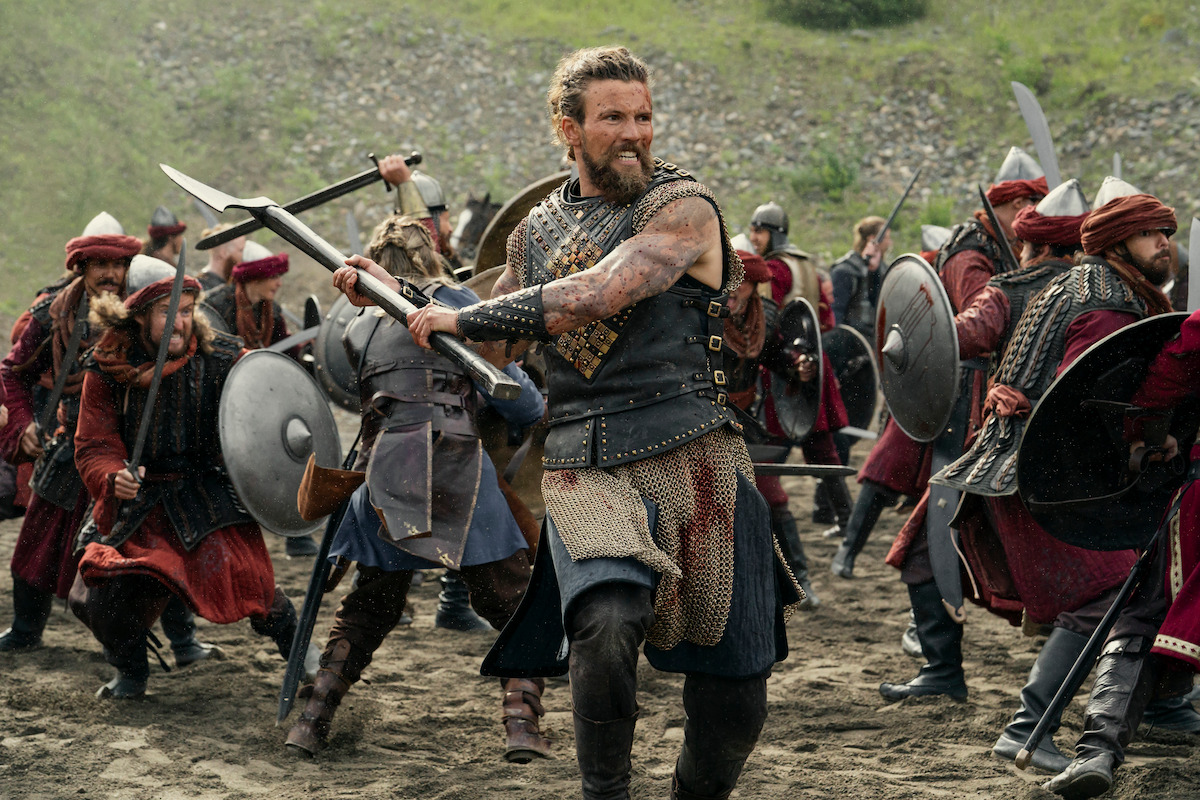
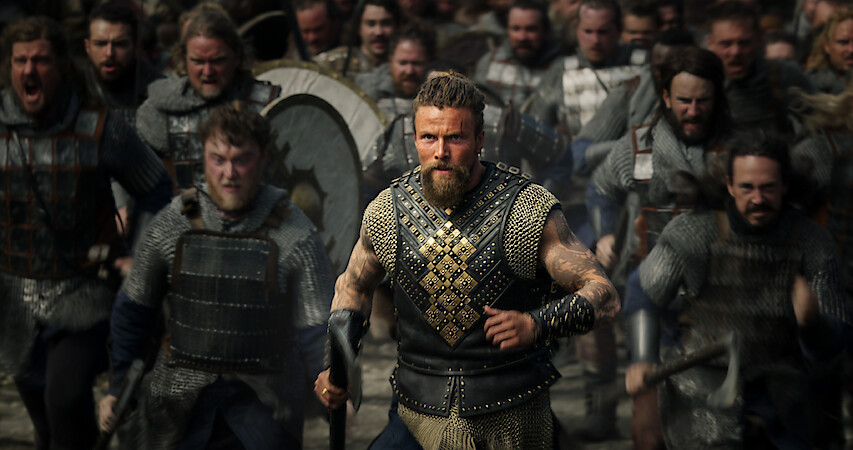
The Varangian Guard was an elite fighting group that provided security for the Emperor, and as the series shows, Harald became its leader. “There were the Varangians inside the wall, they look after the Emperor, and the Varangians outside the wall,” Pollard says. “They’re like the Navy SEALs.”
Many of the Varangians were Scandinavian transplants who had moved to what at the time was known as Kievan Rus. “They are extremely warlike, they’re very loyal and they’re pagan, so they’re great [assets to the Emperor],” says Pollard. “They’re people who have no skin in his game. They have no interest in who he is, what he is. And as we know throughout the whole of our Viking seasons, Vikings will work for money.”
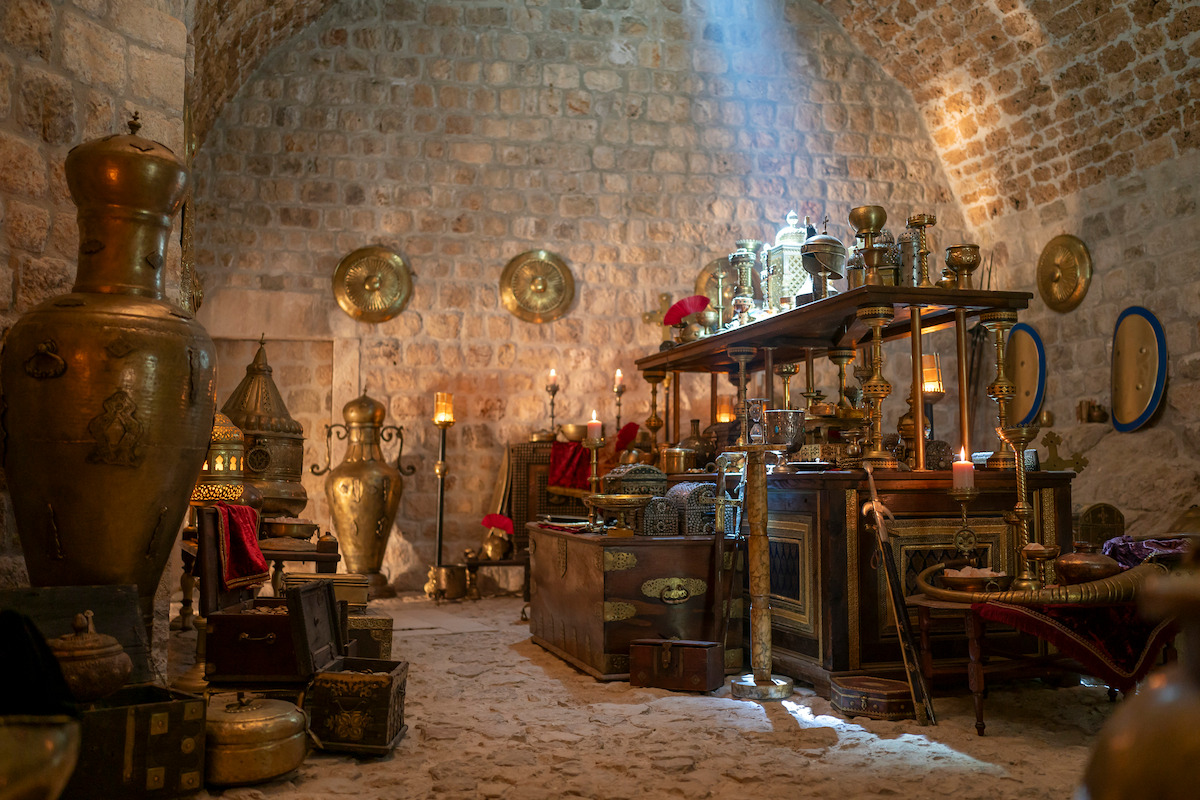
Harald’s grand plan always focused on bringing home loads of money to fund his claim to the Norwegian throne. Luckily, the Varangian Guard really did have access to some big gold nuggets. Like in the series, they occasionally got first dibs on the Emperor’s gold room. “As a Varangian, you get paid very well,” says Pollard. “Also, there are these very weird occasions that happen when an emperor dies where the Varangians are given an amount of time basically to pillage the palace to take the gear. It’s a bit like one of those shopping sprees on a TV show: a Supermarket Sweep.”
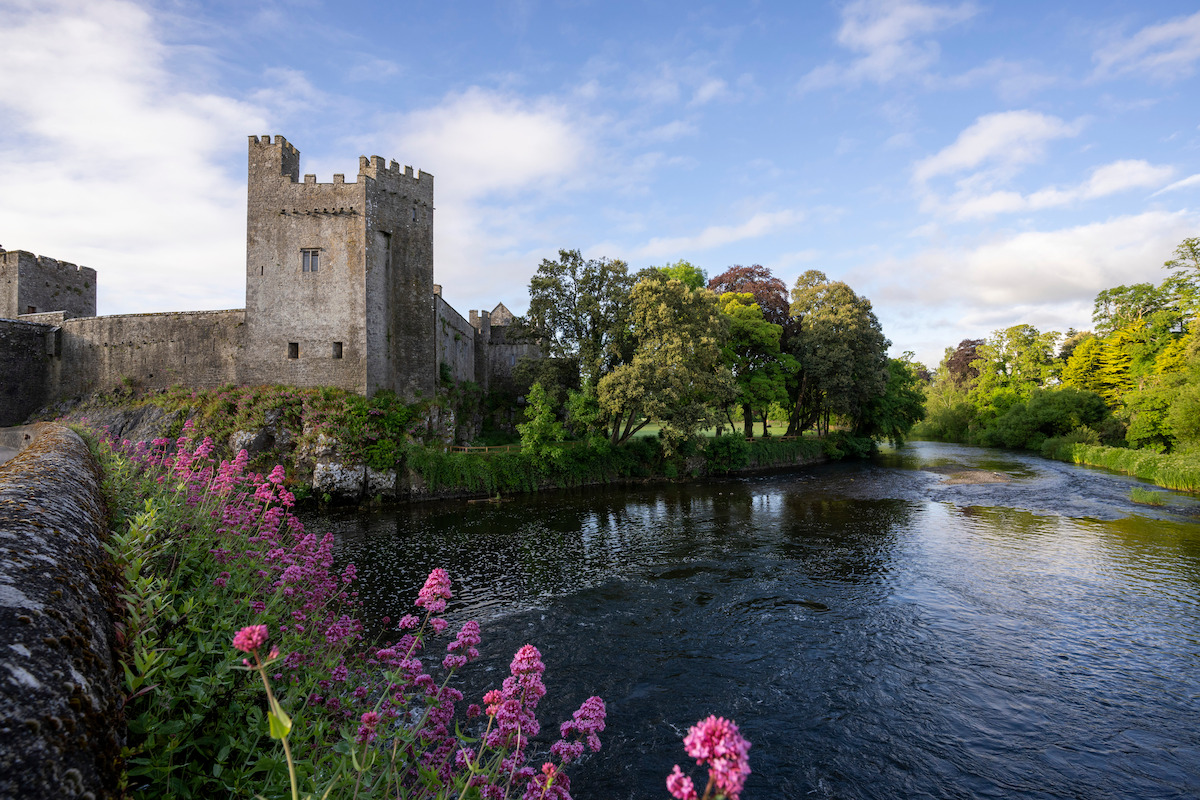
The Byzantine Empire went to war against Sicily and tried to seize Syracuse, which was part of an Arab state and posed a direct threat to the Emperor. “We know that the emperor wanted to take Syracuse from the Saracens, which had a settlement in Sicily,” says Stuart. Pollard adds, “It was this fantastic citadel with a castle in it, almost impenetrable … They sent their very best general, George Maniakes.”
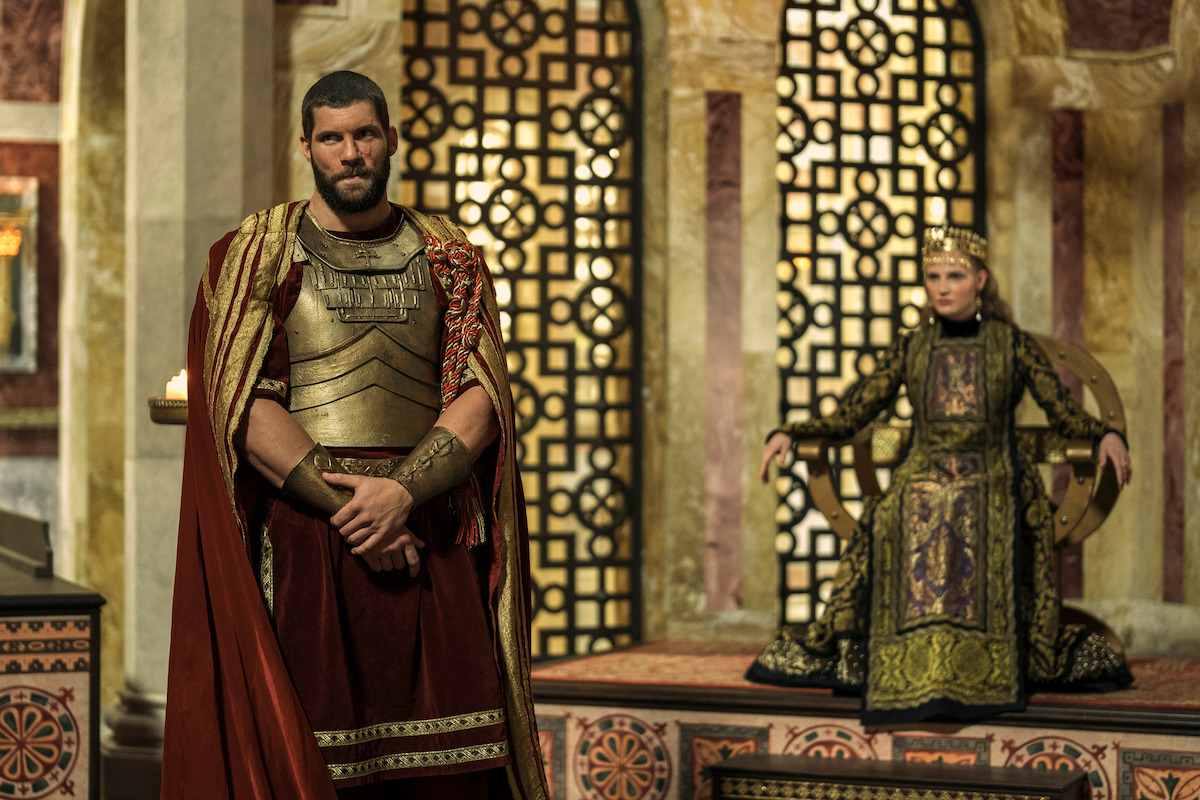
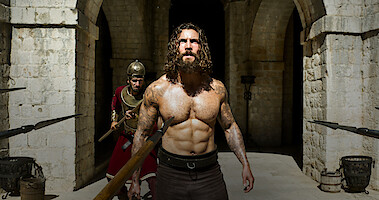
Maniakes, played by Florian Munteanu, was a giant of a man, both in terms of his physical size and his reputation. “In historical fact, Harald and Maniakes fought together, but Harald was in charge of about 700 of the Varangian Guard, whereas Maniakes was in charge of thousands and thousands of Byzantine soldiers, and their rivalry was legendary,” says Stuart. “What we know about Maniakes was he was a huge man. He was almost like a Goliath.”
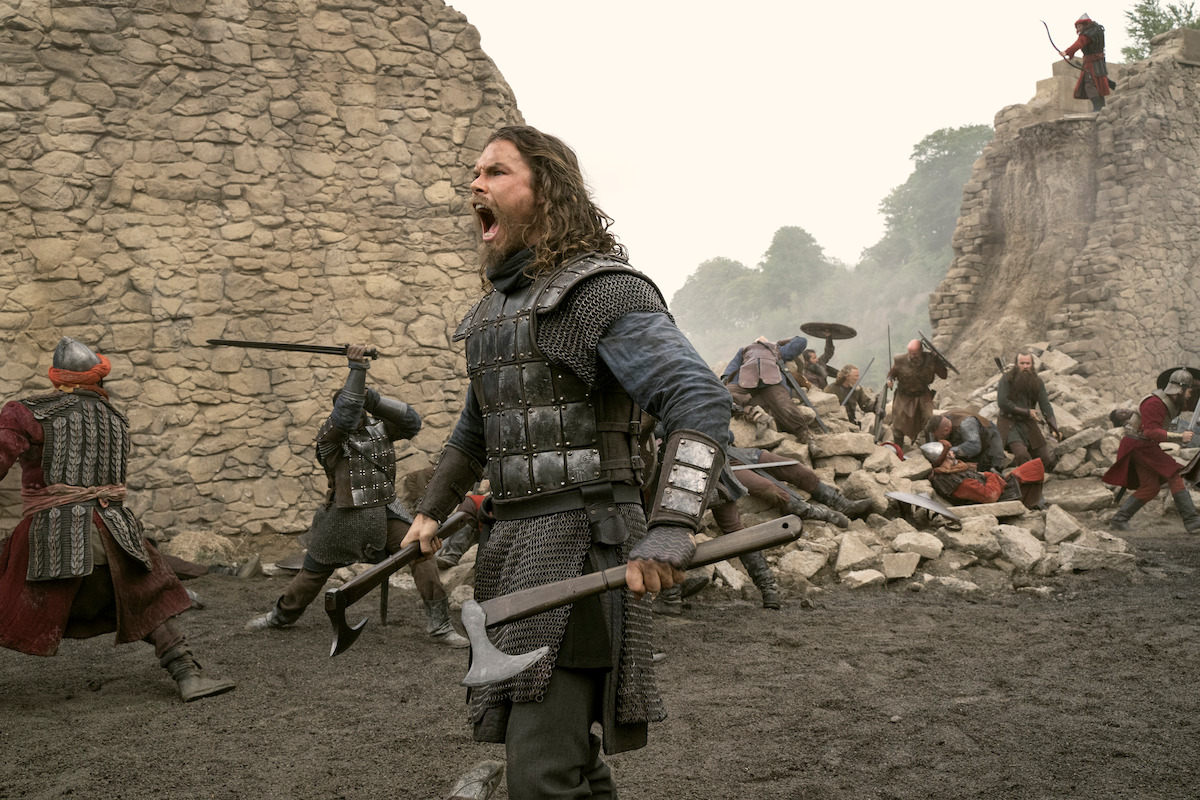
While searching Leif’s scroll-filled laboratory, Maniakes discovers a barrel filled with a stinky, highly flammable yellow powder. He also discovers Leif’s plans for a kind of trebuchet, which he adapts for deadly purposes. Maniakes rounds up prisoners into a courtyard, launches the powder into the area, and lights it ablaze. Leif witnesses the fiery massacre and blames himself for the horror. “Almost every weapon that you’ll see in this scene has been crafted specifically for our time in Italy,” says Stuart.
“This is before the invention of gunpowder, certainly before the invention of gunpowder in the West,” Pollard says. “Byzantines have Greek fire, which is some sort of flammable liquid that’s like napalm, which they spurt out the front of ships and they put in hand grenades. Although we have no evidence for Syracuse being taken in this way, we are taking the best of the technology we know of the day and saying, ‘Well, bearing in mind this siege happened, how could they have done it?’ ”
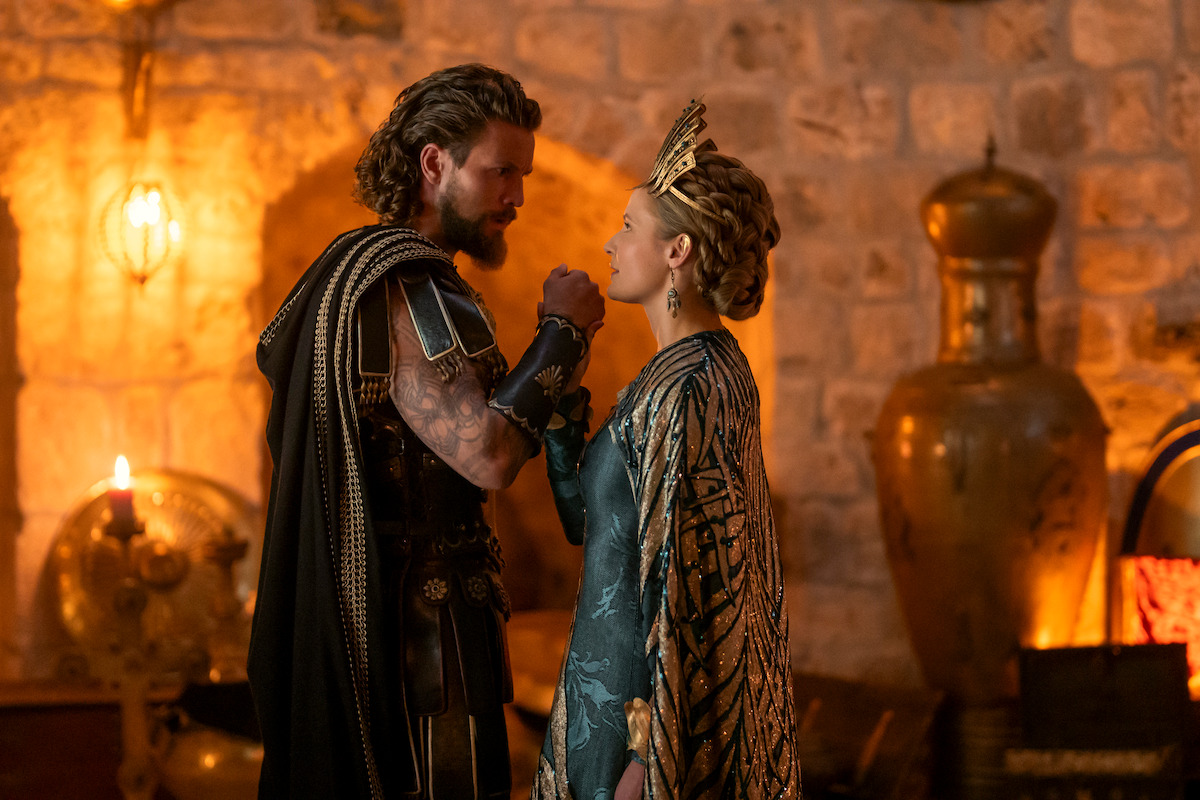
The truth is murky on this one, but Zoe (Sofia Lebedeva) was the real wife to Romanos (Nikolai Kinski). “The Byzantine story at the time [was that Harald] had asked to marry a relative of Zoe’s,” says Pollard. “It was considered to be like an attempt on the throne, [and] he was rejected. We’ve taken it a step further and suggested he’s actually having an affair with Zoe. Zoe was an extraordinary woman, who did have a number of affairs, largely for political purposes, so it’s certainly not impossible.”
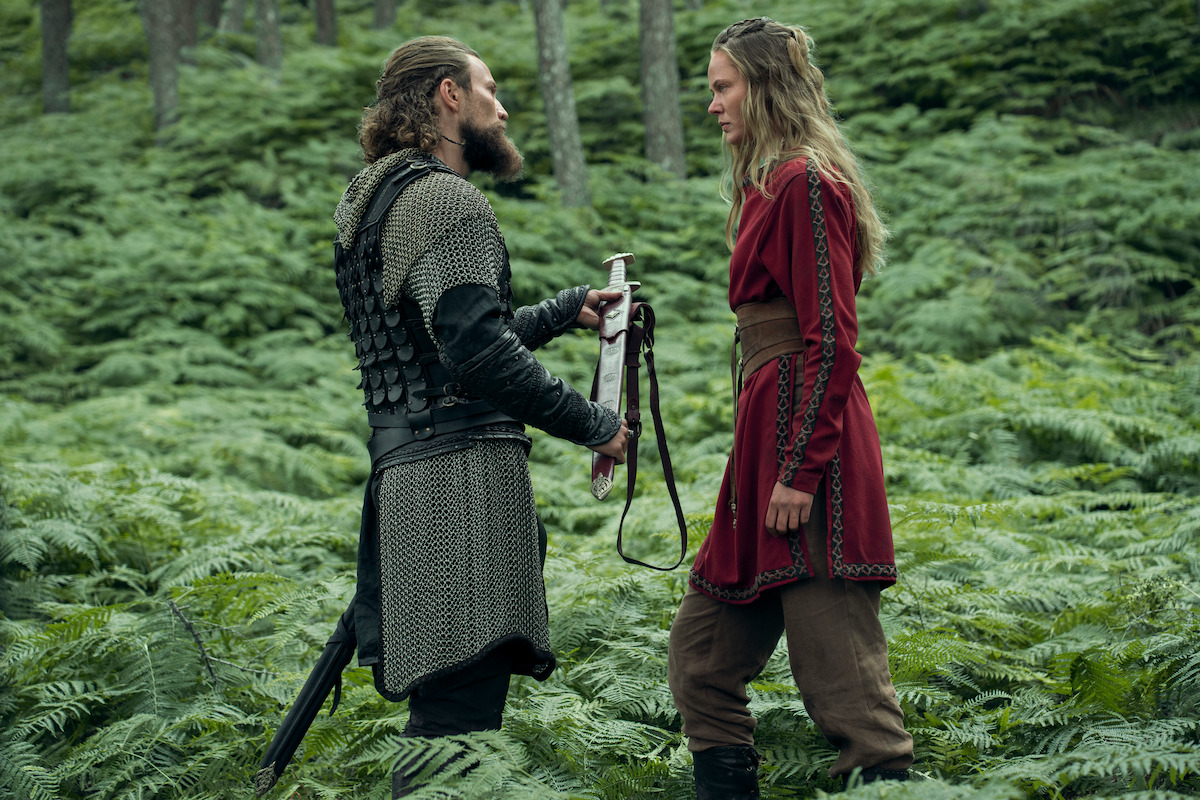
Freydís really was a daughter of Erik the Red, but the relationship between Harald and Freydís is fiction, says Pollard. “That’s something that we created,” he says. “It’s a case of taking those little historical bits, those few jigsaw pieces you’ve got, and coloring in the bits in between them.” In the series, Freydís was the representation of the old Viking world, where pagans reigned — but little is known about her.
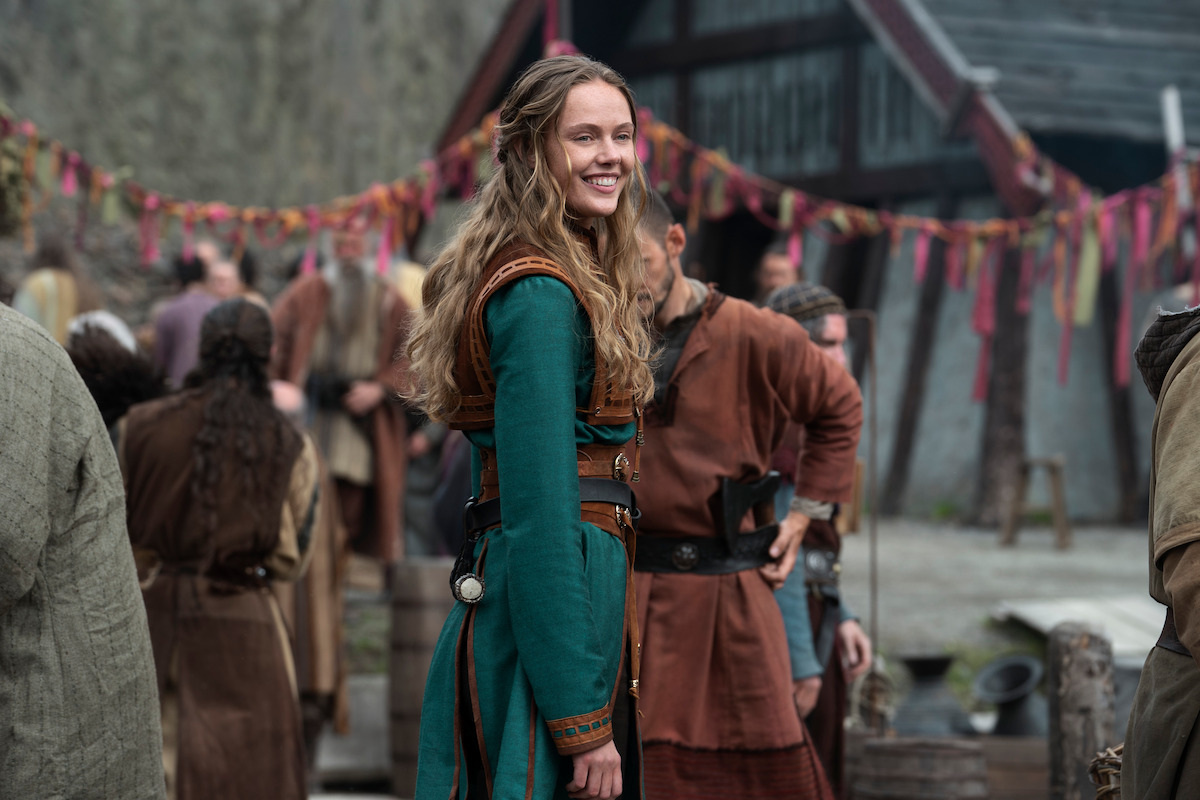
Jomsborg was a “holdout of pagan Vikings,” according to Pollard, which made it the perfect place for a pagan leader like Freydís. “We took Freydís, who was a real character, and made her our perfect pagan Viking and sent her to the perfect pagan Viking location: Jomsborg. We think [it] was an island in the Baltic. We don’t know exactly where. It became quite notorious for what Christians called piracy, but it did preserve an older Viking culture. And placing [Freydís] there enabled us to weave her story with Harald and Leif Eriksson, who was her brother.”
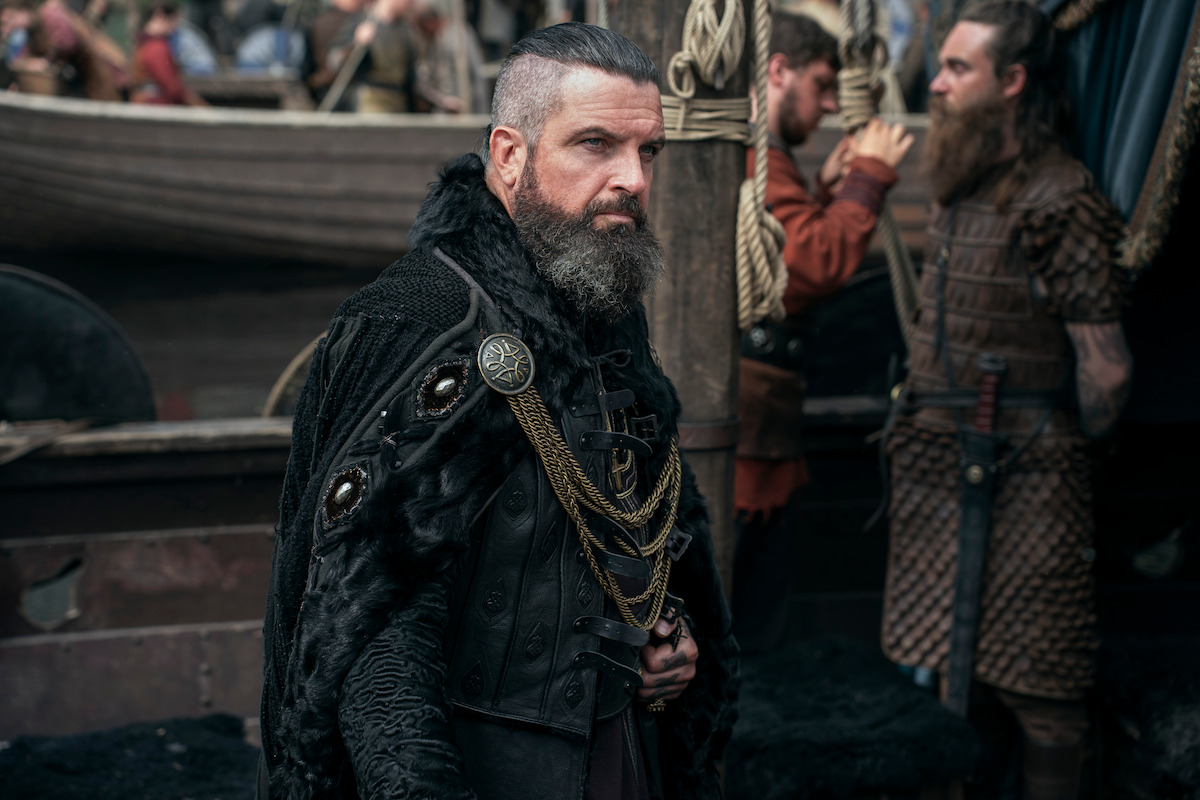
Yes, Canute made the long trek from the north all the way to the heart of the Christian empire, and it was a crucial moment for him. “There was a new Holy Roman Emperor being crowned — Holy Roman Emperors had to be crowned by the Pope — and Canute gets an invite. This is a big deal. This is the Met Gala,” says Pollard. “He’s been invited because he’s not just King of England: He’s got Norway and Denmark, part of Sweden. So he’s become a big player, and because he’s on the edges, he’s of interest to the Pope.”
Stuart says, “I was always fascinated by the idea of what it would be like to have this tattooed Viking warrior kneel before the Pope, something that you couldn’t even begin to imagine 200 years earlier in the Viking story.”
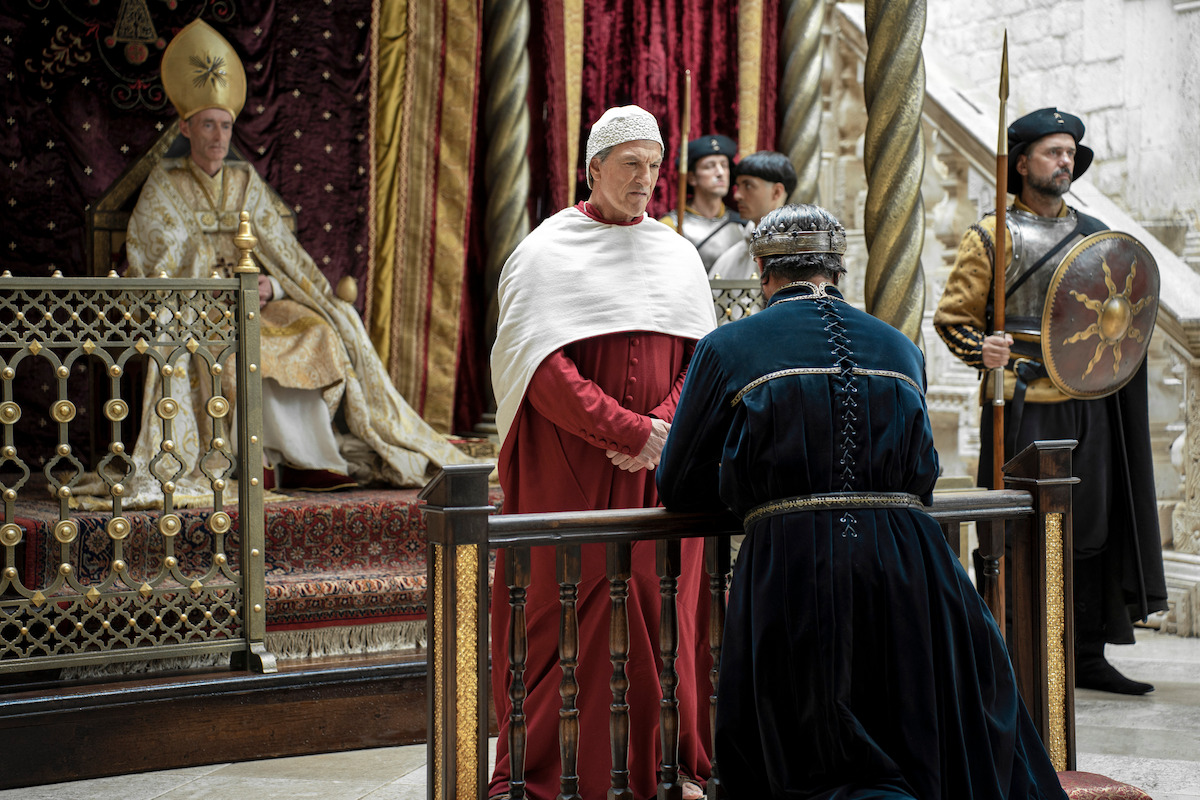
Even though, says Pollard, there was a “slight taint over him about paganism” in Scandinavia, Canute was treated well by the Pope. But there was a catch: Canute had to build more churches. Pollard says that this tactic was “the power politics of the period.” The Pope required “churches in every parish, and every church is going to have to have a priest, and all those priests are going to have to have a bishop. And all those bishops are going to have a cardinal, and the cardinals all report to the pope. So you set up a separate power structure in your country. It’s like Succession — it’s a real power play going on.”
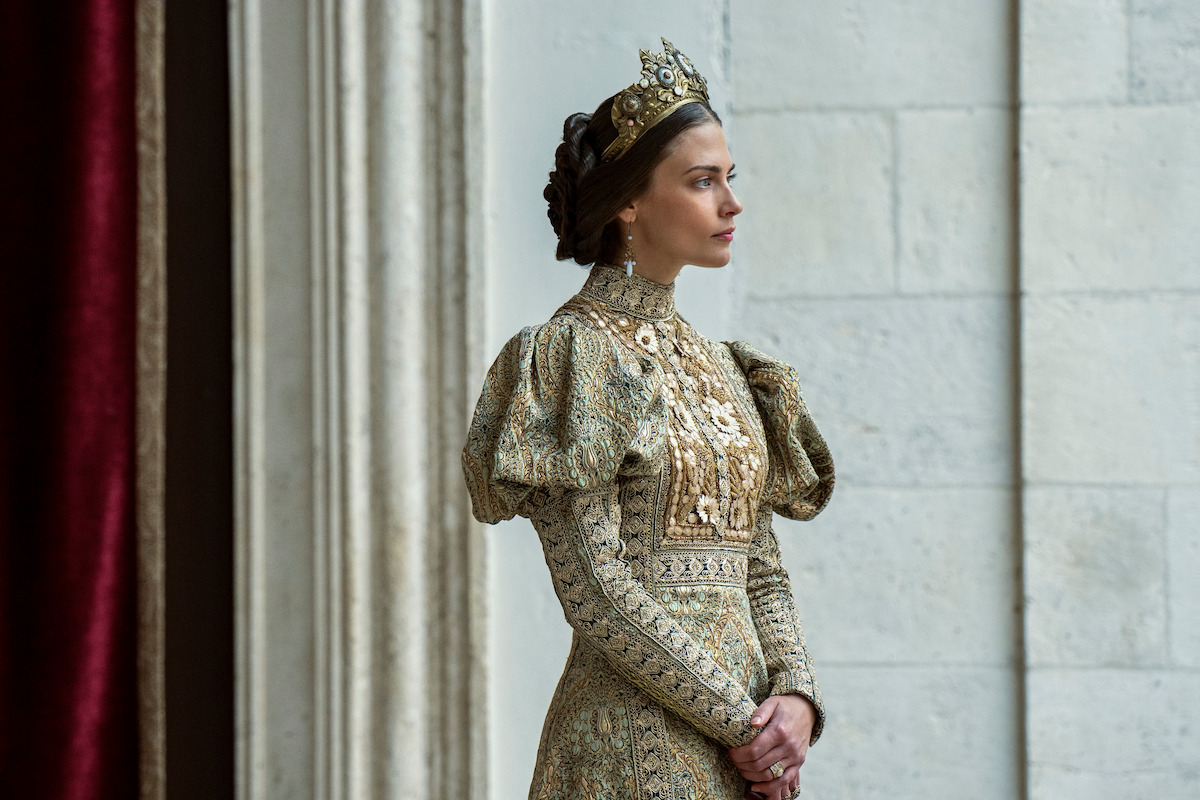
According to Stuart, Canute really did bring Emma with him to the meeting of the Pope because she wielded a great deal of power. “Even though she’s a Christian character and a Norman, she does retain a lot of power, which is unusual for Christian women,” says Pollard. “Because she is the mother of so many potential heirs to so much of northern Europe, England, Sweden, Denmark, Norway, she’s brilliantly educated.” Pollard adds that there was even a book written about her during her lifetime, Encomium Emmae Reginae, which tells her side of the story.
“We wanted [to show] she is that great thing, that part of medieval history you never get to see, which is the powerful women,” says Pollard. “They project soft power. They’re not shield-maidens, they don’t go around wielding swords. They don’t get into battles. They use family, marriage, alliances, children, poison, diplomacy — much softer forms of power.”
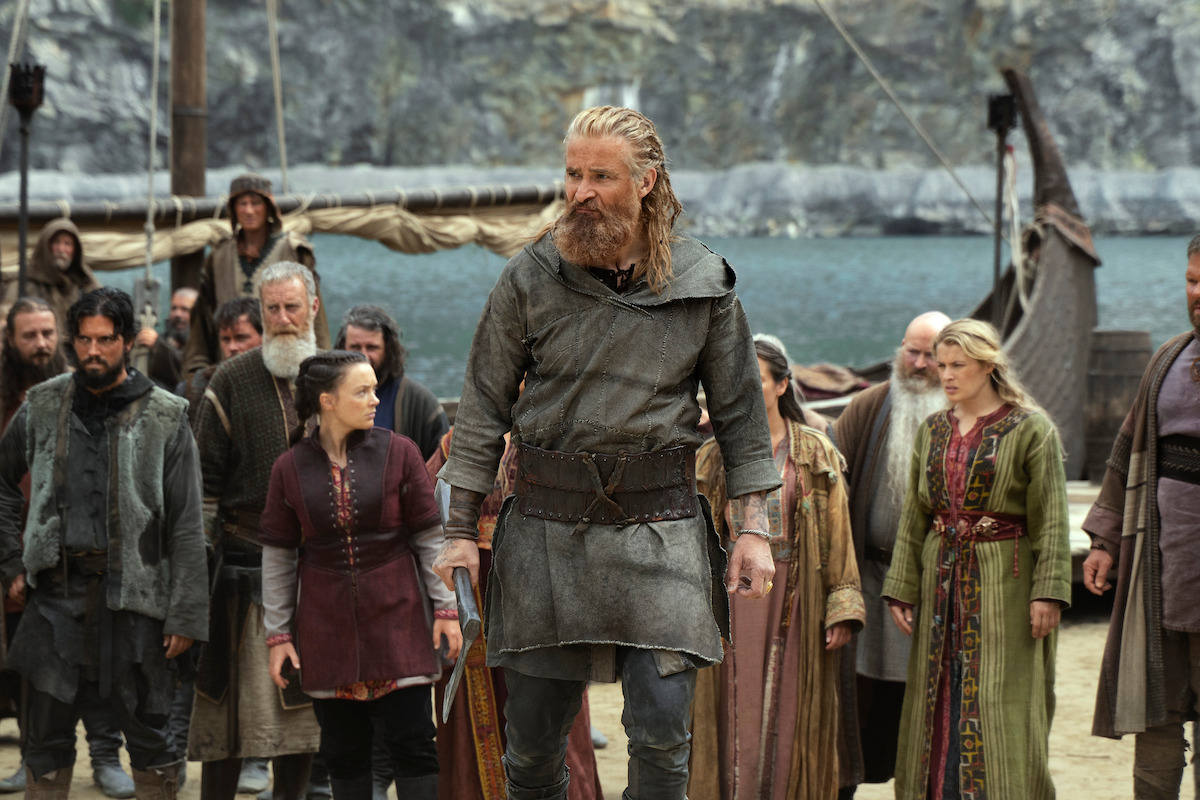
Erik the Red was a great explorer featured in the Icelandic Sagas, and he was Freydís and Leif’s father. “He was a Norwegian and he went to Iceland where he stayed with his family,” says Pollard. “He’s one of these turbulent characters and he gets kicked out. He gets kicked out of Norway as well. And he decides to head west and ‘discovers’ Greenland. He decides that he can make this place another great Viking settlement, his own sort of country really.”
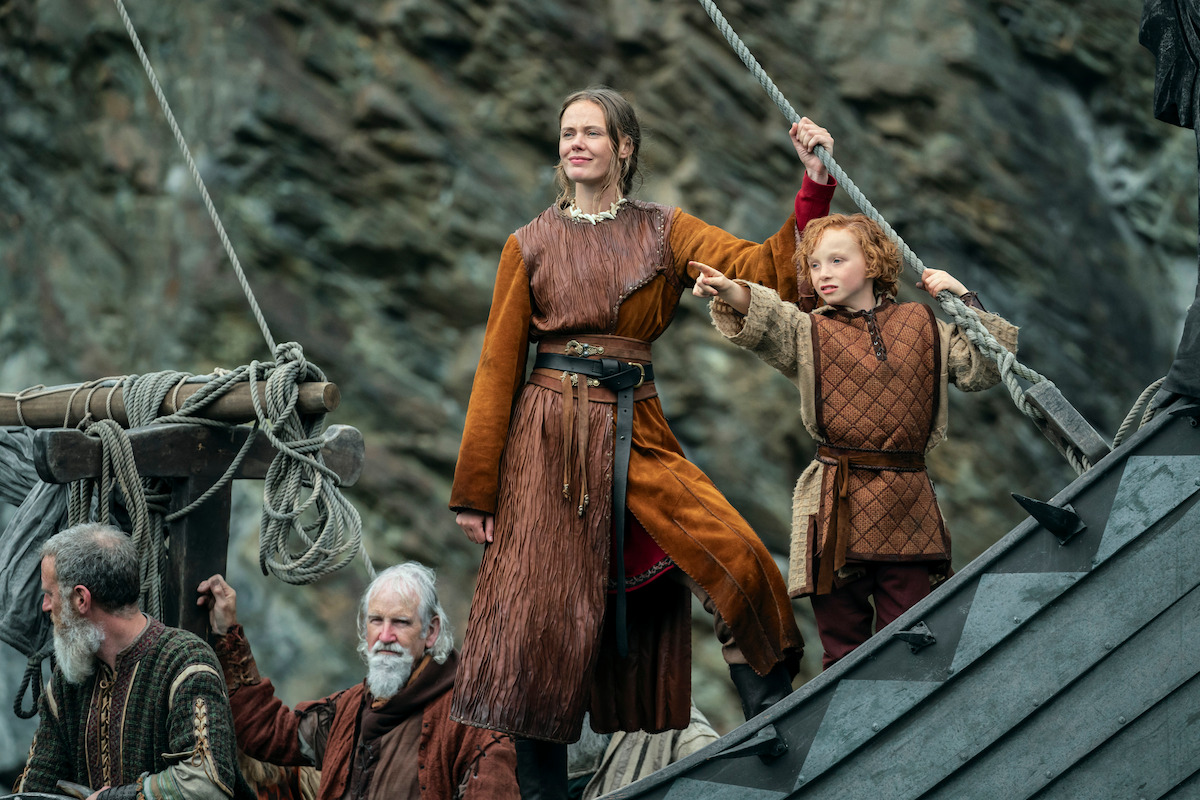
Leif and Freydís dream of a golden land in the West where they can eventually settle down. In the sagas, that world is called Vinland, but was it actually real? “We do know now that because of archeological finds in Newfoundland that the Vikings really did get to the New World, that they established a community there, a hub that they could go off and explore,” says Stuart. “They did spend some time there, and they did interact with the Indigenous peoples in that area.”
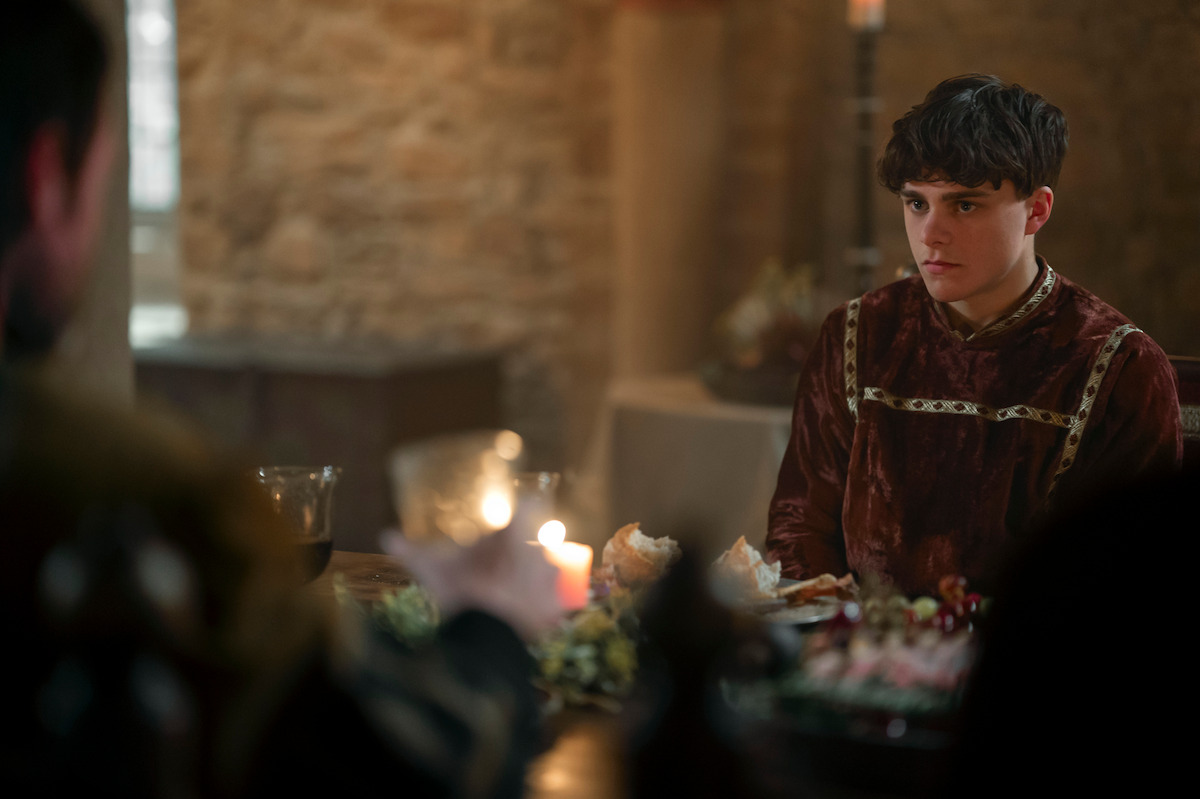
One big surprise for history buffs is the appearance of William the Conqueror — as a teenager — in the series. “If there is any Easter egg that we leave our audience with, it’s that we introduce a young man in Normandy, who is a descendant of Rollo and is the nephew of Queen Emma,” says Stuart. “He goes by the Duke of Normandy or William the Bastard, and our audience will know him later as William the Conqueror.
“His defeat of Harold Godwinson [the King of England, son of Gytha and Godwin] sets an end to the Viking era. We know that that incredible Viking era showed that you could explore all over the known world, that boldness and that adventurousness, that ability for women to own property, to rule empires, to divorce their husbands if they want.
“I think that’s one of the things that excites an audience about Viking stories. They’re not just adventures, they’re not just violence, but they had a wonderful egalitarian spirit that we like to embrace.”