Interview
In Conversation with the Lust Stories 3 Directors
The filmmakers discuss the latest installment of the Indian anthology film series.
By Ingrid Ostby
Sept. 22, 2026
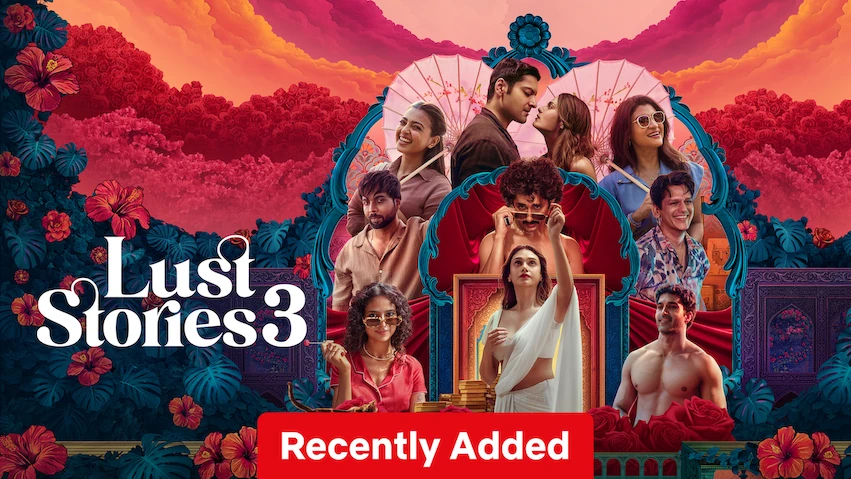
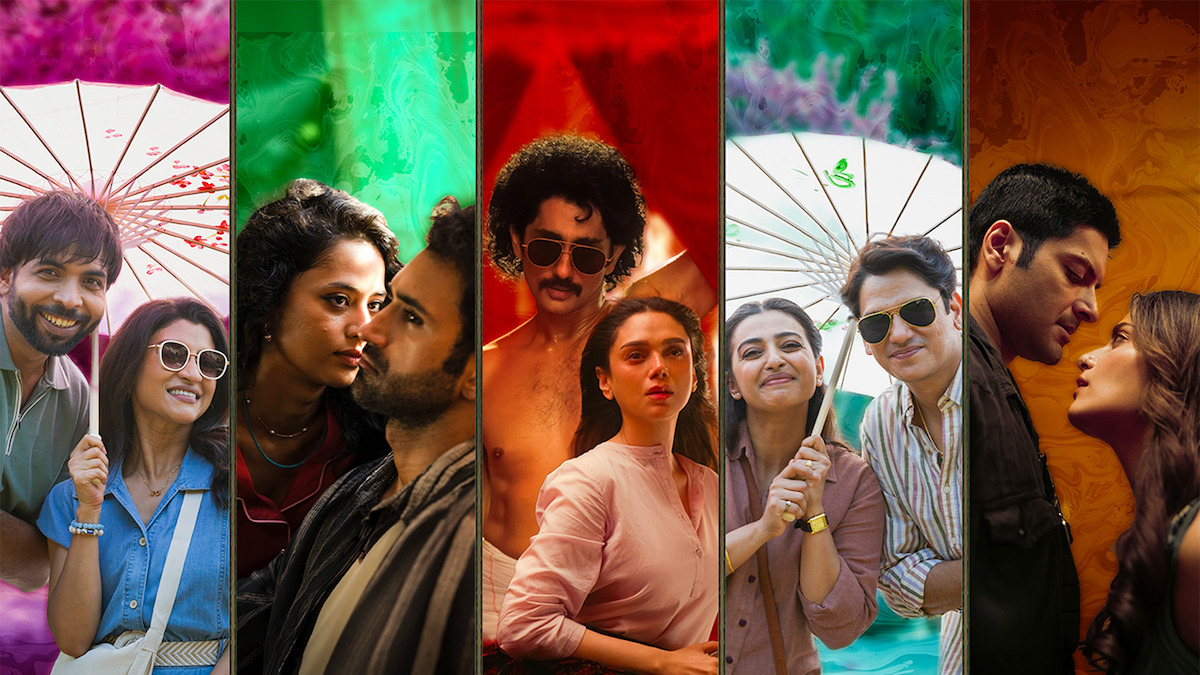
In the latest edition of the anthology film series Lust Stories, directors Vikramaditya Motwane (CTRL), Kiran Rao (Laapataa Ladies), Shakun Batra (Kapoor & Sons), and Vishal Bhardwaj (Khufiya) showcase stories of passion, love and all that’s in between. The anthology contains four short films. The first, by Motwane, follows two best friends who decide it’s time to spice up their marriages by swapping husbands; the second, by Rao, sees a woman get caught up in a whirlwind romance with a shifty delivery man; the third, by Batra, is about a couple mid-divorce whose sexual chemistry threatens the proceedings; and the fourth, by Bhardwaj, centers on a lecturer whose imagination runs wild after delving into erotic literature. The films are tied together in one timeline spanning decades, with characters overlapping between them. Tudum spoke with the directors about the latest anthology — and what this season’s stories say about human desire and intimate relationships.
In what ways did you want to push the narratives in Lust Stories 3, especially compared to Lust Stories and Lust Stories 2?
Vikramaditya Motwane: There was a need to tell something that’s not been told in the first two iterations, and also [to] challenge ourselves — and challenge myself at least — to be able to tell a story that can be a bit different, a bit stranger, a bit funnier than things I’ve done before, while staying in the world of love stories.
Kiran Rao: I was interested in the ways in which lust works in a young, contemporary setting outside the conventions of marriage, and how it can be weaponized to manipulate emotions. The impulsiveness of desire set amid the hustle and pressures of city life make for an engaging story — something that begins as a simple attraction can very quickly take you somewhere unexpected.
Shakun Batra: We’ve already had two editions that have explored desire in very different ways. The more interesting question for us was: What does desire do to people? What happens when it enters a life that already has its own rules and arrangements? With my film particularly, I was interested in desire as something that can quietly reappear in a life you thought you had understood.
Vishal Bhardwaj: What felt worth exploring was the secrecy around desire, especially in the 1980s. There was so much that couldn’t be spoken about openly, particularly by women. I found it interesting that my protagonist [Saira, played by Aditi Rao Hydari] finds a private space through writing where she can express things she perhaps couldn’t even say aloud. And ironically, that secret expression eventually opens up something in her marriage.
What did you feel was worth exploring this time around?
Motwane: Because three out of the four films are about married couples, we had to be able to look at the idea of lust and sex inside couples that’ve been married for a while and to understand what that means in their relationships.
Rao: We often talk about desire as something very physical, but it can be much more psychological and emotional than that. There’s an element of a game to it, a dynamic interplay of power between people, and that’s what I’ve tried to explore in my story in a light and fun way.
Batra: We tend to dramatize desire through betrayal, guilt, secrecy, infidelity — somebody has to be hurt for the story to become interesting. I was curious about whether desire could actually open something up instead. Can it make you look at yourself or your relationship differently? I also liked the idea that intimacy and companionship are not static things. You can love someone deeply and still have parts of yourself that remain unexplored. Those two truths don’t necessarily cancel each other out.
Bhardwaj: What interested me was exploring lust through language and imagination, rather than just physical desire. My film is set in the 1980s and follows a young woman, a PhD scholar and teacher, who is challenged by her students to write erotica in Hindi without making it crude. For me, the story became about desire, fantasy, and a woman discovering her own voice — and how all three can unexpectedly transform a relationship.
How do you view the moral questions that come up through these stories — swapping husbands, outmaneuvering a drug-dealing boyfriend, finding solutions outside of marriage — whether that’s through divorce or other ways to fulfill your desires? What was important to show about the choices these characters made?
Motwane: [In my film], we didn’t explore it as a moral question, really, as much as a question that the two women [who attempt to swap husbands] want to be able to solve a problem in their lives. It’s a story about two friends and what they’re trying to do, and it’s meant to be absurd, and [we’re] playing it with a sense of humor.
Rao: People make choices based on what they want, what they fear, and what they believe in. Those things can be contradictory. I wanted to allow my characters to be messy and make their own choices.
Batra: I don’t think any of us were particularly interested in being moral referees. That’s probably what I enjoy most about this format. You can put people in slightly messy situations and resist the urge to tell the audience who is right. For me, the interesting question is less, “Was this the correct choice?” and more, “Do I understand why this person made it?” All four films allow their characters to make imperfect, complicated choices without immediately punishing them for it.
Bhardwaj: [My segment] was really about desire, fantasy, and a woman discovering her own voice through writing. Women have been repressed for centuries by a largely male-dominated society, and particularly so in India. What I find ironic is that this is also the land of the Kama Sutra and the temples of Khajuraho, where sexuality and the human body were once represented so openly and beautifully. And yet, over time, sexuality became something shameful and taboo.
The anthology features several women characters who really take charge of their love lives. Can you speak about how that came about, and why it was important to this edition of the series?
Rao: Women’s desires and fantasies have not been explored enough in popular media in a meaningful way, so it’s interesting that all four filmmakers approach it from their own standpoint in their films. This commonality was without any discussion or brief from the producers — it emerged organically.
Batra: A woman should be allowed the same messy interior life that we have always comfortably given male characters. Sexual agency is part of that. Not because every woman needs to be sexually liberated in the same way, but because she should get to decide what intimacy, desire, and love mean to her. For me, that’s much richer than trying to construct a conventionally “strong female character.”
Bhardwaj: It is very important today to create stories where women can speak about their desires, enjoy their sexuality, and make their own choices without being judged or looked down upon.
Each film takes place in the same universe during different time periods — whether weeks or decades apart. What’s the significance of having these stories span across time?
Rao: The rules around relationships keep changing, but desire and lust haven’t really changed that much. What was considered bold or unacceptable in one period can become completely ordinary in another. So placing these stories across time lets you see a changing landscape and yet how human impulses remain the same.
Batra: You start seeing what changes, but also what stubbornly doesn’t. People still want to be loved. They still want to be desired. They still get jealous, curious, lonely, excited. The circumstances change; the human mess remains remarkably consistent.
Bhardwaj: Time changes, society changes, the way we live changes — but our basic desires, emotions, and vulnerabilities remain the same.
What would you like audiences to take away from these films?
Batra: That we shouldn’t become too certain about ourselves. We spend so much of our lives building an idea of who we are, and then life occasionally comes along and embarrasses that certainty. I find that quite beautiful.
Bhardwaj: The moral of the story, if there is one, is that obscenity does not lie in the language — it lies in the intention of the writer. If the writer’s intention is honest and their aesthetic sensibility is profound, even erotica need not feel vulgar or cheap.
Anything else you’d like viewers to know about Lust Stories 3?
Batra: What I really like about this edition is how much tenderness there is underneath it. Yes, there’s sex and desire and people behaving badly and strangely, but ultimately these are stories about people trying to negotiate intimacy — trying to figure out what they owe another person, what they owe themselves, and whether those two things can coexist. I think that’s why we keep making stories about lust. Sex is rarely just about sex. It’s usually where all the other stuff we’re carrying finds a way to reveal itself.
Watch Lust Stories 3 on Netflix now.