
Illustration by Bráulio Amado
Ask an Expert
So, How Hard Is It to Do the Quint We Saw in ‘Cheer’?
We asked a physicist.
By Charlotte Walsh
Jan. 18, 2022
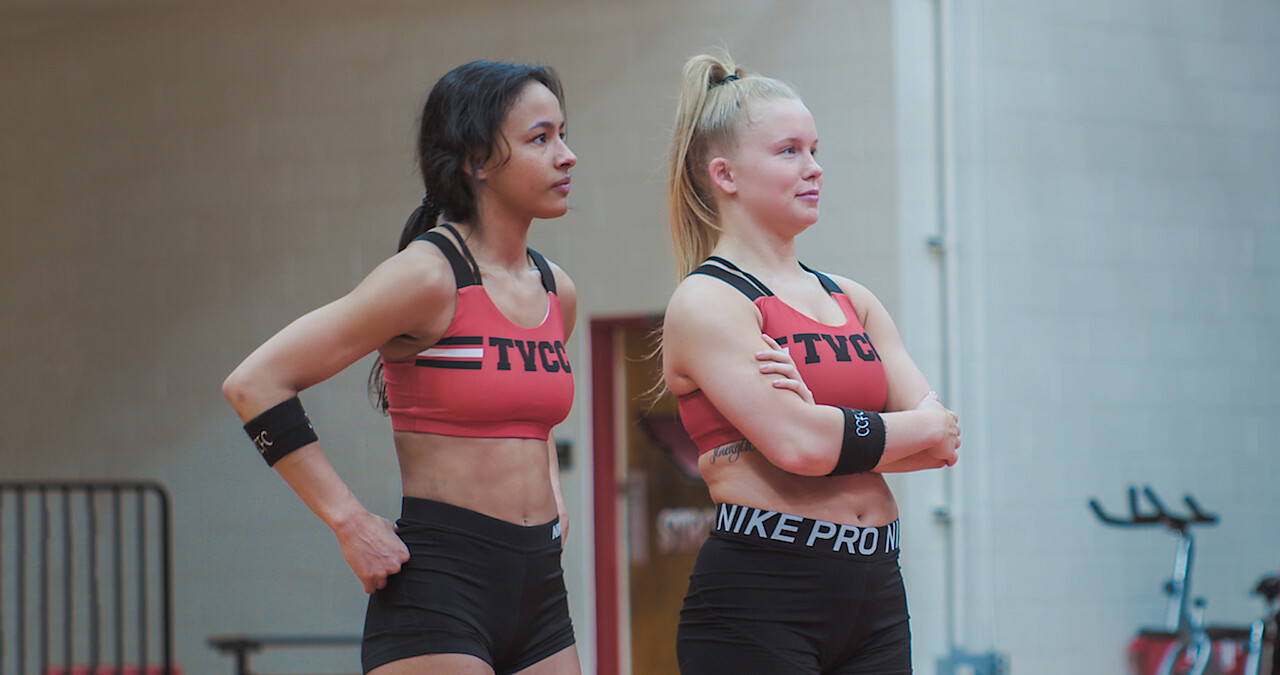
In Cheer Season 2, Navarro College faces competition from an especially powerful class of Trinity Valley Community College rookies. One of those up-and-comers is DeVonte “Dee” Joseph, who can pull off a rare skill: the quint.
“Dee does things that just… that don’t seem natural,” TVCC assistant coach Khris Franklin says in Episode 6.
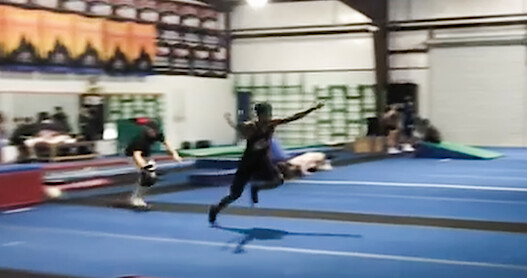
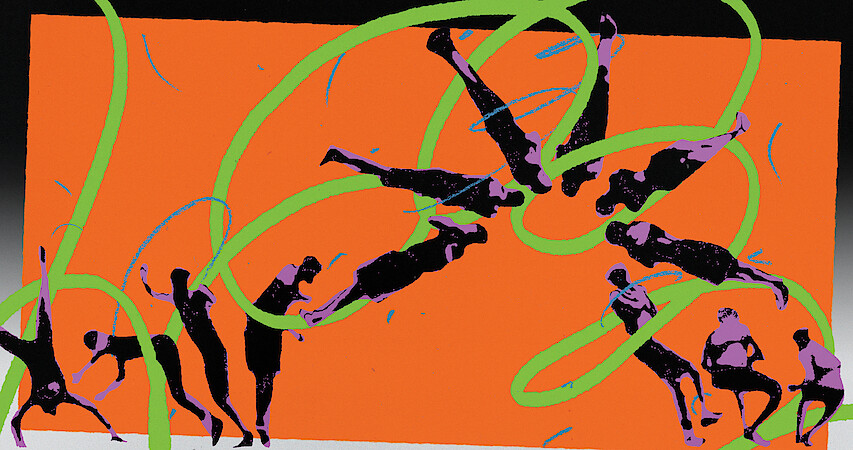
Technically called a full twisting layout, the quint combines flipping upside down and twisting simultaneously while the body is fully extended. One 360-degree rotation is a “full,” Joseph says; five makes a quint.
The move, Joseph explains, is illegal to do at Daytona because it’s considered “outside the realm of gymnastics.” But it’s a rare skill — one that happens so quickly in the air that Franklin says it’s difficult to even see. “Five spins, you’re gonna have to put him on slow motion and count,” he says. “The human eye can’t recognize five spins in one skill.”
So, how is a move like that even physically possible? We asked a physicist to break it down.
Cornell Jenkins, aka The Sports Physicist, uses physics principles to improve the athletic performances of everyone from high school basketball stars to Olympians. Here, Jenkins explains each step that has to go right for a quint to land, including approximately how much force is required — and what, exactly, can go wrong.

Joseph starts off the quint with a roundoff — a move similar to a cartwheel that you might see in an introductory tumbling class. But landing with his feet together gives him the power to thrust himself vertically. “From a physics perspective, the key to successfully completing this flip comes down to how high he can jump and how long he can stay in the air,” Jenkins says. “A powerful roundoff is essential to getting the spring needed to start the sequence.”
Now time for the real math: Jenkins uses basic kinematics to calculate roughly how much force Joseph needs to pull this off. “If we assume he’s in a standing position, on solid ground and in the air for 1.15 seconds, we can approximate his peak height to be 1.62 meters,” Jenkins says. “Assuming he’s about 70 kilograms, our back of the envelope calculations tell us the force needed to leap a distance of 1.62 meters is about 2,670 newtons, or 600 pounds. That’s almost four times his body weight!”
The success of this flip, Jenkins says, is also heavily dependent on how quickly Joseph can spin. Immediately after the roundoff, Joseph brings his arms close to his body to lower his moment of inertia. “Moment of inertia, in simple terms, is the body’s resistance to change in angular motion,” Jenkins says. “In this case, it would mean things with a larger moment of inertia are more difficult to rotate.”
Jenkins compares it to spinning around in a computer chair. If you swivel with your arms outstretched, you’ll go a lot slower than if you hold your arms close to your sides. This is because you’ve decreased your moment of inertia, and it’s what allows Joseph to rotate so quickly in the air.
The most dangerous part of the stunt, Jenkins says, is the landing. Athletes can get something called the “twisties,” a phenomenon where they lose control of their bodies while spinning. It can be the difference between landing on their feet or not — which could mean potential injuries.
Because the flip’s height builds so much potential energy, Jenkins says it’s important that Joseph lands with his knees bent. Landing with bent knees increases the time of deceleration during the landing, which in turn decreases the force. If he lands with straight legs, the force of landing is much greater. “When traveling from a height of 1.62 meters,” he says, “tenths of a second can be the difference in hundreds of pounds of force.”
Ultimately, Jenkins says, highly trained athletes like Joseph are able to combine these physics principles for a successful quint (and, while it can’t be performed at Daytona, that sure is impressive). “Cheerleading is the essence of poetry in motion,” Jenkins continues. “It’s the ultimate display of art from some of the world’s best athletes.”