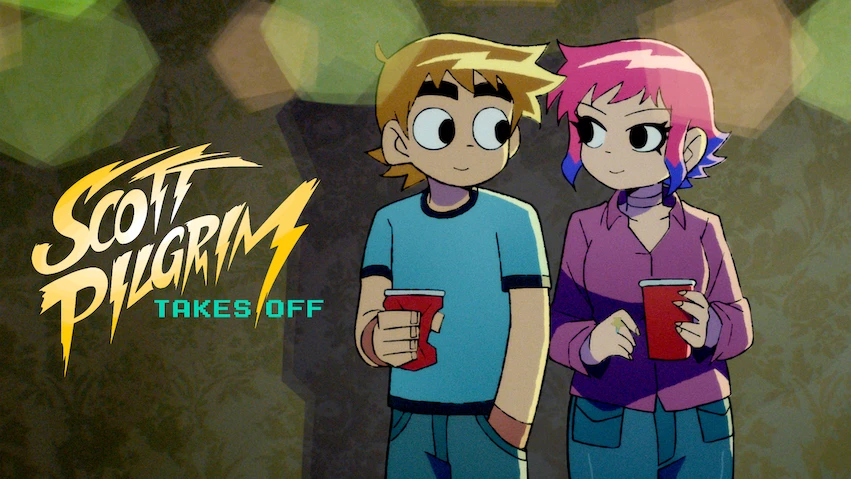
Whether you’re a superfan of Sex Bob-omb or would rather rock out to The Clash at Demonhead, there’s one thing we can all agree on: Music is key to the Scott Pilgrim universe. (The bassist takes his name from a 1997 song by Canadian power pop band Plumtree, after all.) And in the new Netflix anime series Scott Pilgrim Takes Off, the soundtrack truly levels up, thanks to a heady blend of genres.
“The music is pretty eclectic compared to the movie,” explains Scott Pilgrim creator and executive producer Bryan Lee O’Malley.
“This show has a taste of everything,” agrees BenDavid Grabinski, executive producer and writer. “You can expect everything from Sondheim to chiptunes to aggressive action scores.”
To craft the wide-ranging soundtrack, production brought on a team of diverse collaborators whose strengths perfectly complemented each other, starting with veteran composer Joseph Trapanese, who’s worked with bands like Daft Punk and M83 to score such films as Tron: Legacy, Oblivion, and The Raid. Then there’s New York–based band Anamanaguchi — composed of lead songwriters and guitarists Peter Berkman and Ary Warnaar, bassist James DeVito, and drummer Luke Silas. The guys are no stranger to Scott Pilgrim, having done the music for Scott Pilgrim vs. The World: The Game back in 2010.
“It kinda feels like having a close friend you haven’t seen for years and being able to instantly pick up where you left off,” say Berkman and Warnaar of stepping back into Scott Pilgrim’s world.
And overseeing it all was director Abel Góngora from the Japanese animation studio Science SARU, who had to adapt his typical music approach for this project. “We have a very different style of music in Japanese animation — scoreless scenes and silences — compared to American productions,” he explains. “So we tried to find a good balance between both styles.”
From that balance emerges an energetic and playful sonic backdrop worthy of our hero (and heroine). Here’s the whole soundtrack and how the creative team pulled it all together.
Episode 101
Anamanaguchi “I Feel Fine”
Anamanaguchi “I Feel Fine (Reprise)”
Anamanaguchi “Orange Shirt”
Cub “Pillow Queen”
X “Breathless”
Episode 102
Metric “I Will Remember You”
Cristina “What’s a Girl to Do”
Episode 103
Tegan and Sara “So Jealous”
Tegan and Sara “You Wouldn’t Like Me”
Episode 104
Liam Lynch “United States of Whatever”
Dead Kennedys “Police Truck”
Johnny Cash “Ring of Fire”
Episode 105
Metric “Black Sheep”
Ultra Naté, Amber, and Jocelyn Enriquez “If You Could Read My Mind”
ZZ Top (Patel Chopper) “Sharp Dressed Man”
Episode 106
Joseph Trapanese “Bread Makes You Fat”
From Into the Woods “Agony”
Anamanaguchi “Emotional Business”
Vampire Weekend “A-Punk”
Scout Niblett “Kidnapped by Neptune”
Episode 107
Pop’n TwinBee “Konya Wa Hurricane”
Anamanaguchi “Emotional Business (Reprise)”
Episode 108
Joseph Trapanese “Scott Pilgrim’s Precious Little Musical”
Anamanaguchi “I Feel Fine Part 2”
Anamanaguchi “God Only Knows”
Anamanaguchi “Mortal Kombat Cover”
Plumtree “Scott Pilgrim”
What is that super-catchy theme song?
The beats kick off right away with the show’s opening credits. Set to the song “bloom,” written by Asahi and performed by Japanese rock band Necry Talkie, the nearly two-minute sequence calls to mind the opening credits from the original 2010 film, during which Sex Bob-omb blows Knives’ mind with the song “We Are Sex Bob-omb” (otherwise known as “LaunchPad McQuack”). The electronic-tinged “bloom” similarly sets the tone for Scott Pilgrim Takes Off with its propulsive rhythm and catchy refrain.
“The first time I heard the opening song, I definitely cried,” says O’Malley. “I was like, ‘Oh my God, my own anime theme song.’ I hope they find huge success and blow up after this.”
Who composed the original score and music?
From there, each episode boasts a mix of tunes from the original movie, needle drops of iconic hits, and original music by Trapanese and Anamanaguchi. Their divergent sensibilities created a dynamic partnership in which both benefited from the other’s perspective. “It’s a very lonely process scoring a film by yourself — the whole world is on your shoulders,” Trapanese says. “This is a great way to spread that weight among several different creative people.”
Among some of the heftier tasks the team undertook while creating around two and a half hours of original music for the series was scoring the multiple fight sequences, which required a high level of precision and collaboration.
“The difficult part was that we use these action sequences to play with the perception of the audience,” Trapanese says. “One four-minute action sequence might have three or five — or in one case, probably six or seven — different musical styles, that we’d have to spend a lot of time working with Abel and Bryan and BenDavid to understand where the spotting was going to be, where each musical style was going to go, how to produce that musical style.”
Here again, Trapanese credits the team’s ability to “divide and conquer” in order to create something cool.
“Me coming from a more classical background, I’d be taking on the more orchestral side of things, while Anamanaguchi might be taking on the more song/8-bit side of things. But then we’d all still be figuring out how to put the puzzle back together and make sure that it flowed.”
How did specific characters influence the music?
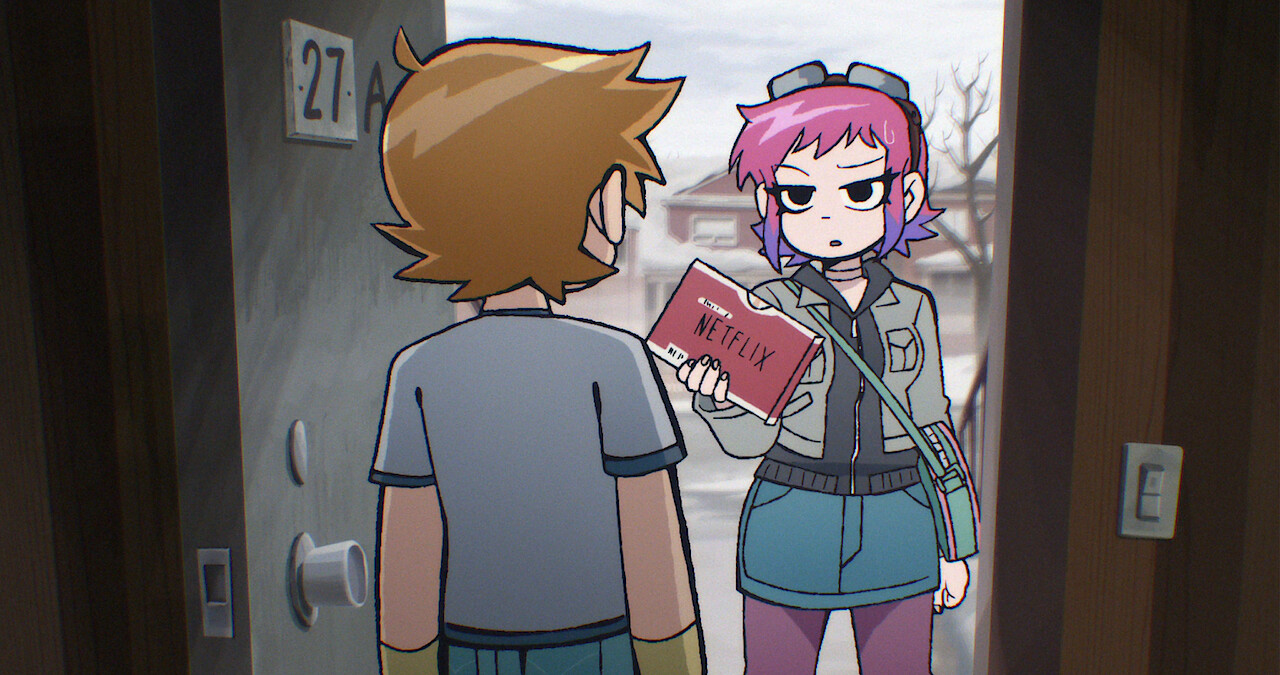
Another welcome challenge for the team was creating a signature theme for Ramona, as she becomes the series’ narrative through line. “Ramona is developed much more in the anime — working on her melodic theme, shaping it in different ways, is a big part of it,” say Berkman and Warnaar. Here, Trapanese took inspiration from one of the great horror maestros.
“One secret about BenDavid and I is that we’re both huge John Carpenter fans,” he says of the Halloween auteur, who also composed the movie’s instantly recognizable theme. “We love his aesthetic. We love his films. We love his music. I think that’s something that comes across right away — the mystery, darkness, adventure, and obsession as Ramona takes on this new storyline.”
What are some songs from the soundtrack that we’d already recognize?
Complementing the team’s original score is an array of hit rock and pop songs, from the strains of “I Will Remember You” sung by Envy Adams to the snarls of “United States of Whatever” playing after Lucas Lee lands the role of Scott Pilgrim. And while Trapanese credits those choices to O’Malley and Grabinski, they ultimately affected the entire team’s process.
“It changed how we worked on the score around those song moments,” he says. “It was a thrilling thing to see.”
What songs from the 2010 film are brought back?
O’Malley and Grabinski also picked a couple of songs from the original film to highlight, including “Black Sheep” and — what else? — “Scott Pilgrim.”
It all adds up to one earworm of a soundtrack fans will surely be spinning over and over again. “I loved how the score mixed with the sound effects and blended with the band’s live performances,” Góngora says. “Bryan and BenDavid had lots of cool songs they wanted to include in every episode. I think it adds a great vibe to the realistic side of the story.”
Scott Pilgrim Takes Off is streaming now on Netflix.