Deep Dive
Take a Hit of ‘Big Vape: The Rise and Fall of Juul’
Everything you need to know about the four-part docuseries.
By Amanda Richards & Rebecca Johnson
Oct. 11, 2023
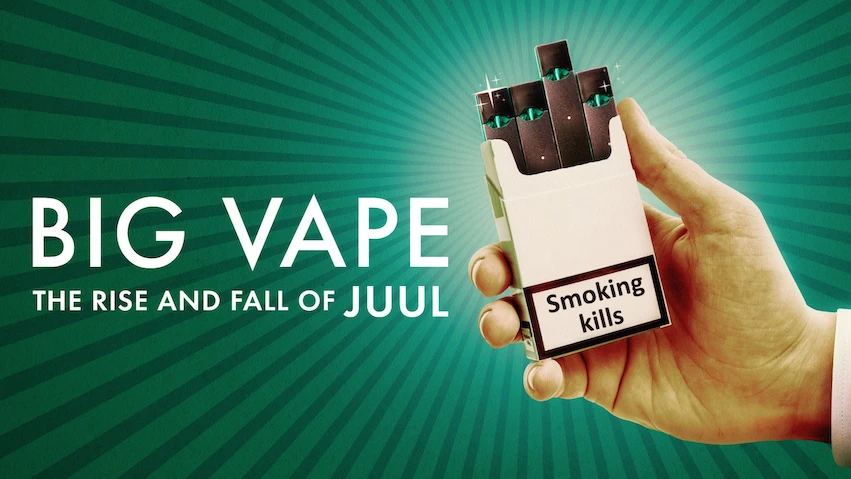
At one time in recent history, Juul was one of the fastest-growing companies in the world. First released in 2015 by parent company Pax Labs, the nicotine e-cigarette was already valued at $38 billion by 2018. It was one of the most spectacular corporate success stories in the making — until it wasn’t.
Big Vape: The Rise and Fall of Juul tells the story of the vaping device that became a household name, exploring how one company’s innovation went from achieving peak financial highs to running into devastating lows. Based on the book Big Vape: The Incendiary Rise of Juul by Time health correspondent Jamie Ducharme, and directed by R.J. Cutler (Billie Eilish: The World’s a Little Blurry; Belushi), this four-part doc series is a cautionary tale about a Silicon Valley darling that sparked tremendous societal impact.
Big Vape: The Rise and Fall of Juul was executive produced by Darryl Frank and Justin Falvey for Amblin Television; Elise Pearlstein, Trevor Smith, and Lindsay Panell for This Machine; and Ian Orefice and Rebecca Teitel for Time Studios.
Yes, the documentary series is based on a true story. Big Vape starts at the very beginning: the early 2000s, when future Juul inventors and co-founders James Monsees and Adam Bowen were both Stanford University grad students, bonding over smoke breaks between their classes in product design. “There was this euphoria around Silicon Valley at the time,” tobacco historian Robert Proctor says in the series. It was an era when, a narrator says, “there was the sense [that] tech can do no wrong.” Perhaps, even, it could do some good. For instance, wondered Monsees and Bowen, why had no one yet created a successful alternative to combustible cigarettes? This became the goal of their senior thesis in 2005, the year Steve Jobs delivered a now-famous commencement speech at Stanford. “Stay hungry. Stay foolish,” Jobs exhorts the graduating class in a clip shown in the series.
Ten years later, after rebranding their first start-up Ploom as Pax Labs and inventing the relatively stylish and discreet Pax vaporizer, Monsees and Bowen introduced the first Juul e-cigarette. Within just three more years, they were at the helm of a multibillion-dollar company. The company that first touted itself as an alternative to the big tobacco industry found itself working within it (Pax Labs was acquired by Altria in 2018), and then, amid a wave of negative media surrounding public health concerns, exponentially devalued. Did their rapid success (particularly among a generation raised on the instant gratification of social media) backfire — and how, and why?, the series asks.
Neither of the Juul co-founders were directly involved with Big Vape: Monsees declined to participate on the advice of his legal counsel, and Bowen didn’t respond to the series’ creators requests for comment, but both are shown in extensive archival footage. Through numerous original interviews with former Juul and Pax Labs employees, investors, Stanford classmates, historians, journalists, and several “teen vapers,” Big Vape presents an in-depth, multi-perspective look at Juul’s meteoric ascent and its equally stunning fall.
Yes, it’s based on the book Big Vape: The Incendiary Rise of Juul by Time health and science correspondent Jamie Ducharme. You can also read some of her previous reporting about Juul for the magazine here and here.
Watch Big Vape: The Rise and Fall of Juul now on Netflix.