[pensive music playing]
[Maggie Baird] Tell us what we have today, Cody.
[Cody] So we have our coconut jasmine rice, our coconut tzatziki, grilled veggies, and spiced chickpeas.
[Maggie Baird] And by the way, this little stuff is so good.
[Cody] Oh, yeah. The cucumber salad? Yeah. Just yeah.
[Maggie Baird] This is a low-income housing, community housing right around the corner from you.
[Cody] Yes.
[Maggie Baird] We started Support + Feed at the beginning of the pandemic when we realized that there was gonna be so much food insecurity. At the same time, restaurants were gonna be struggling. Because I care so much about the environment and all things sustainability, and all things health, we really wanted to provide plant-based meals for people. So we started with the mission to feed people who are experiencing food insecurity and address climate change by making sure every meal that we provided was plant-based. We provide that meal from local community restaurants. And we support all things from the farmer to the server in the price of our meals. So we're also addressing local economies.
[Cody] If we're — if it's a slow week or a slow couple of weeks, Support + Feed's always there to give us a little bit extra, which allows us, at the end of the day, to kind of hit that bottom line. It sounds funny 'cause it's a business still. And in order to pay people what we want to pay them, not what we have to pay them.
[Cody] Awesome.
[Maggie Baird] Thank you, Cody.
[Cody] Of course. So happy to help.
[Maggie Baird] So much. Thank you.
[Cody] Have a great day. Have fun.
[Maggie Baird] Both Billie and Finneas are very supportive of Support + Feed. [cameras clicking] On Billie's tour, we made all of the food for the crew, which was a hundred meals, three times a day. So 300 meals a day, fully plant-based. That was a massive savings on water and carbon methane. Take the pledge to eat at least one plant-based meal a day for 30 days.
[applause]
[Billie Eilish] Thanks, guys.
[Maggie Baird] So quite proud of that. One in five people in 2022 experienced food insecurity. College students, families, children, not knowing where their next meal is.
[woman 1] We've got another meal.
[woman 2] This is really wonderful. I love.
I love all the time. Thank you.
[woman 1] Yeah, look at it.
[Maggie Baird] At Support + Feed, we are not walking into communities and organizations and telling people what to do. We're there to listen. We're there to learn. We're there to support.
[Maggie Baird] Yeah. It's our pleasure. But if you have feedback or things you like, please let us know.
[woman 3] OK.
[Maggie Baird] Yeah.
[woman 3] Oh, Mediterranean bowl.
[Maggie Baird] But what we're there to offer them is a nourishing meal that also can be an entry point into discovering plant-based food as an option in people's lives.
[woman 3] We were never exposed to this kind of food, you know? So in the beginning, it might taste, like, awkward, but then it was delicious.
[laughter]
[Maggie Baird] We can be the first touchpoint many people have toward, "Oh, this meal is delicious. Oh, this meal is good." "Oh, I feel good after I eat that." Part of our mission of Support + Feed is to make that connection for people with what they eat.
[bright music playing]
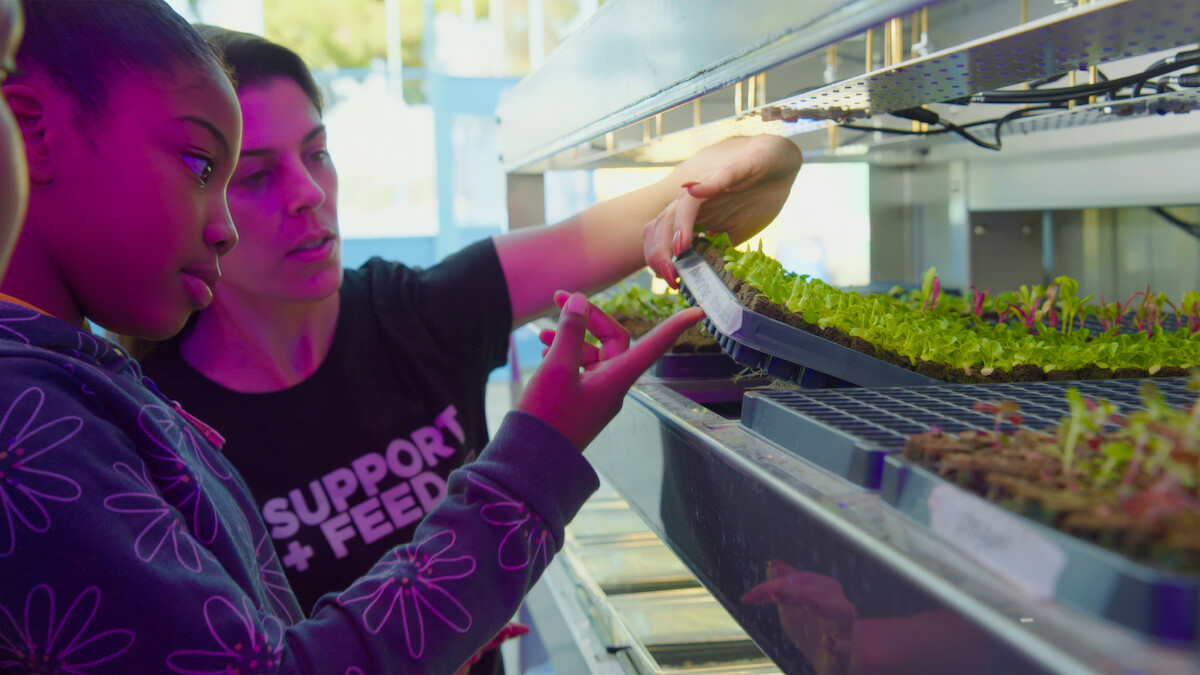
[Saralyn] Do you remember when we tasted the nasturtium and smelled it, and it was kind of peppery? Microgreens, some of that has that peppery, spicy taste. These are the romaine and rainbow chard. We planted these a few weeks ago. So you can see all the roots that's like spaghetti down there. And they're growing out to get the water from the bottom.
[Maggie Baird] We have been delivering meals to the Boys and Girls Clubs of metro LA since almost the beginning of the pandemic. It's been an amazing partnership. And so, we were fortunate to offer the Hydro-Wild Lab, which is a hydroponic farm in a freight car.
[Saralyn] When this tray is full, there's 280 seedlings on here.
[Maggie Baird] The kids get to do the planting of the seeds, watch the growing, be involved in the whole process. And they have a curriculum not only about hydroponic farming, but about plant-based food, about growing vegetables, about fruits and vegetables, about health and wellness, and really see the process from start to finish.
[woman 4] When you guys are cooking, you want to look at the whole recipe before you get started. So what we're gonna make is a salad wrap, basically. You want to mix your sour, your savory, your sweet. So that's what's happening right here.
[Maggie Baird] We know that children are gonna be more excited to eat something if they grew it.
[woman 4] We got all plants today.
[boy] Exactly.
[woman 4] So you're vegan for lunch today! Yay!
[Maggie Baird] We realize, "Oh, this is a bigger mission." We realize that we could be most impactful if we partner primarily with organizations who experience food insecurity and food apartheid.
[pensive music playing]
[woman 5] All right, so I got green onions, chives. I got some cabbage.
[Maggie Baird] We are working in Detroit with Taste the Diaspora, providing food from the farm to the chefs to cook the food.
[Ederique] So we'll help him get the Hoppin' Johns done, and, um, we can also start working on the braised collard greens and cabbage.
[Jermond] Taste the Diaspora is a food agency that's centered around celebrating Black history's relation to food, Black food, Black expressions with food. We are contracted as Taste the Diaspora from Support + Feed to provide plant-based meals in areas of need. All right.
[Jermond] We are preparing plant-based family-size meals for the Jefferson Chalmers neighborhood. The area is food insecure. The term "food sovereignty" is our ability to feed ourselves, but also produce, manufacture, sell food too. I am an urban gardener. I have, like, a half acre of land. Urban gardening is just the lifeblood of our food system here. We wouldn't have the restaurants, we wouldn't have the grocery stores or the expression of food that you see here today without our urban gardeners. We got Hoppin' Johns, braised, or as I call braised vegetables, uh, leafy vegetables, collard greens and cabbage, creamy cornbread. Culture-appropriate food is, uh, important to feed people because it's their culture.
[Ederique] All right, I got 40 cornbreads in already.
[Maggie Baird] [chuckles] I mean, it just seems so crazy obvious, you know? If you have the opportunity to provide a million meals, and you could make them more sustainable and more culturally appropriate, and, you know, address all the inequities in the system. There we go.
[laughter]
[Ederique] Thank you. Thank you for coming out. Please let anybody else know if they need a meal, come and see us.
[man] OK. Thank you.
[Ederique] We got some Hoppin' Johns in there, so that's some peas and rice with some braised cabbage and collard greens and some cornbread.
[woman 6] It's right here.
[Ederique] Y'all enjoy.
[woman 6] Oh, that is so nice.
[bright music playing]
[woman 7] You go carry that, I carry this.
[girl] Thank you.
[woman 8] You're welcome.
[woman 7] Thanks, y'all. Thank you.
[woman 8] Have a good night.
[woman 8] All right, thank y'all. Y'all enjoy.
[Jermond] At the end of the day, the work that we have to do as Detroiters the work we have to do as Americans, we can't do it eating fast food every day.
[Ederique] How y'all doing? Good.
[Jermond] You can't build community or redevelop neighborhoods without food.
[Ederique] Some braised cabbage and collard greens with cornbread.
[Maggie Baird] You don't wake up —