What do you think of when you think of Denmark? Mid-century modern design, The Little Mermaid, hygge and, of course, beloved political drama Borgen. The show achieved worldwide success a decade ago — it was so successful, in fact, that Netflix has revived the show for a fourth season, almost a decade after it originally ended.
Described by passionate fans (OK, this author) as a Danish West Wing or House of Cards, Borgen debuted in 2010 and offered viewers a look inside the titular Danish capitol by following Birgitte Nyborg (Sidse Babett Knudsen) as she’s elected the first woman prime minister of Denmark, along with political strategist Kasper Juul (Pilou Asbæk) and journalist Katrine Fønsmark (Birgitte Hjort Sørensen), who plot — and analyze — the prime minister’s every move.

Birgitte Nyborg is back at work.
Mike Kollöffel/Netflix
In Borgen’s first three seasons, Birgitte realizes that accomplishing her political goals requires major sacrifices in her personal life. But she isn’t the only one who compromises: Katrine also pushes her family aside to become a superstar political anchor. Though the women had forged an alliance by the end of Season 3, when we meet them 10 years later in Borgen: Power & Glory, they’re at odds once again — and both in new positions of power. Now Birgitte is shaking off nearly a decade of her post-PM life, booking corporate speaking gigs to assume leadership of her center-left political party, the New Democrats. Katrine, meanwhile, is heading back to her old stomping grounds at TV1, this time as the boss, instead of an anchor. (Kasper, Katrine’s ex and the father of her daughter, does not appear in Power & Glory, and, so, is presumably happy in his new life off-screen in London.)
For as much has changed in the characters’ lives over the last decade, one thing has not: They’re still grappling with complicated power dynamics in both their personal and professional lives.
“[Power is] this poison that just drips into your coffee. You think you’re just drinking coffee, but it’s just something bitter. It’s not good for you,” Knudsen tells Tudum. “But power is also the opposite of not having power and not being heard and not being seen and not having any influence in anything. And I think it’s so connected to [Birgitte’s] identity, being in power, being heard, being a decision-maker. It’s addictive.”

Katrine’s old boss is now her subordinate.
Mike Kollöffel/Netflix
Borgen has always been an examination of power, and, specifically, the power it takes for a woman to climb the ladder in male-dominated fields like politics or journalism. The first three seasons depict the highs and lows of ambition, as both Birgitte and Katrine keep their eyes on their respective prizes. But, in Season 4, long after they got what they wanted (and some things they definitely didn’t) a new question emerges: Was it worth it?
It isn’t only the characters who are reassessing their choices with the benefit of a decade’s worth of hindsight. For Knudsen, who re-watched the first three seasons when she was approached to revisit the character, part of the appeal of imagining how Birgitte would have changed was thinking about how the world has changed, too. And yet, Knudsen did have some reservations. “I thought, ‘It’s not going to be simple,’” she says, remembering those initial doubts. “But,” she continues, “turns out, it was simple. She just fits like a glove.”
Perhaps that’s because, while Birgitte might be older, her quest for power was — and is — not just for self-serving reasons. It was always a part of her mission to ensure a better future for Denmark. And this mission is one that resonates with Knudsen, who was excited to play a woman who didn’t retreat from the world as she got older, but only became more relevant. “It’s just really important that we don’t tell a story that [contends], when you’re a woman of 53, you should basically just resign and do yoga for the rest of your life," Knudsen explains. Priorities might change, but Birgitte’s moral compass remains intact.
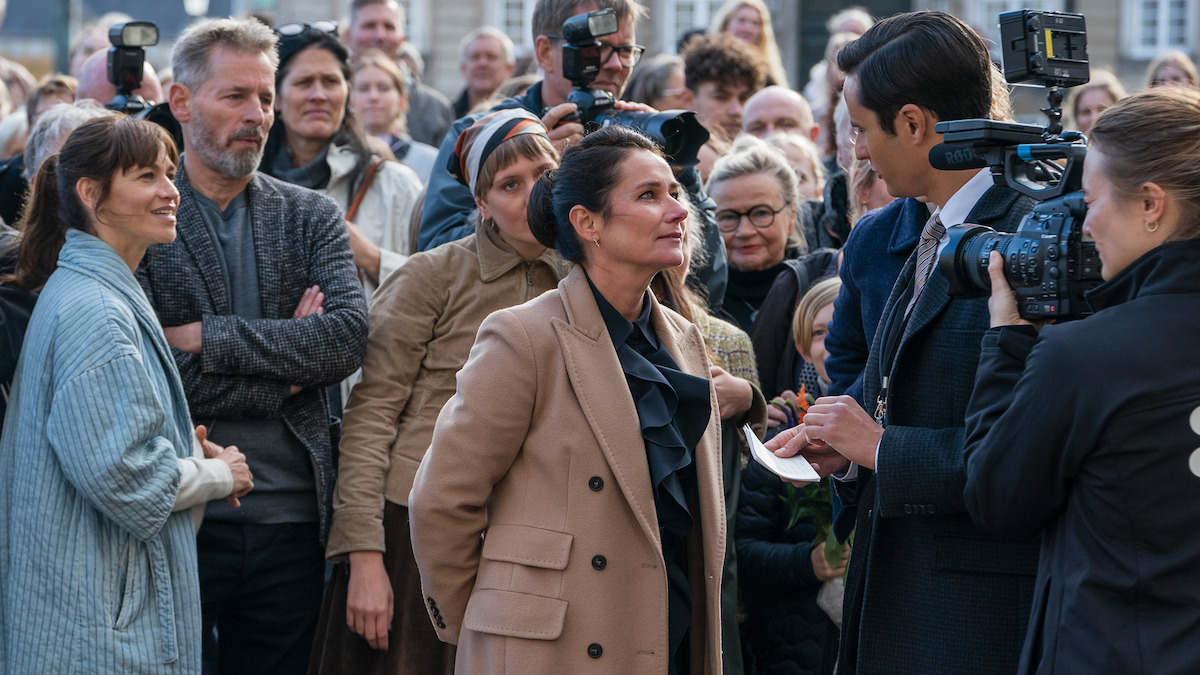
Birgitte is questioned by reporters, something she has always prioritized.
Mike Kollöffel/Netflix
For Sørensen, Borgen wasn’t just another job; she tells Tudum she became “an adult” on the show, just as Katrine did. It was her first part out of drama school, and it’s where she learned the basics of acting on-camera, and of being part of a crew. Her character, too, had to learn sometimes-difficult lessons — like the fact that her “very headstrong, ‘I’m right, you’re wrong,’ black-and-white view of the world” wasn’t the only way to view her personal or professional life.
Reinhabiting Katrine was something that made Sørensen reflect on her own experiences these last few years and what that’s done to her own ambition. “Age-wise, I’m the same as Katrine,” she says. “So going from 30 to 40, which is what I’ve gone through in this decade, for a lot of people that’s where you start a family, and maybe your pace isn’t quite as fast as it used to be.” And, Sørensen adds, “maybe the pandemic in general has done something to all of us in terms of how we prioritize.”
While there are bound to be changes in how things work and how people live over the course of a decade, one thing in particular has accelerated that rate of change: social media. Now integral to the political landscape, online agitators have changed the way politicians and journalists do their jobs, for better and worse. In Power & Glory, Sørensen says, “Katrine really encounters this massive force that is social media. It’s a story that she can’t control. I’m not sure anybody could have foreseen what a massive power it is that people’s voices can be heard unfiltered all the time.” How that force dictates what it is that Katrine and Birgitte can and can’t do plays a big part in the new season of Borgen.
But even if Katrine and Birgitte struggle a bit in this new world, the actors who play them see the value in these types of developments — and see how plenty of power is still up for grabs. “Politicians can speak directly to the people,” Sørensen says. “Of course, they should be able to do that, but they also need to have reporters and journalists asking them questions, holding them accountable. And if they shortcut that system, it’s ultimately a problem for democracy.” It sure does make for good TV, though.
Borgen: Power & Glory debuts on Netflix June 2.