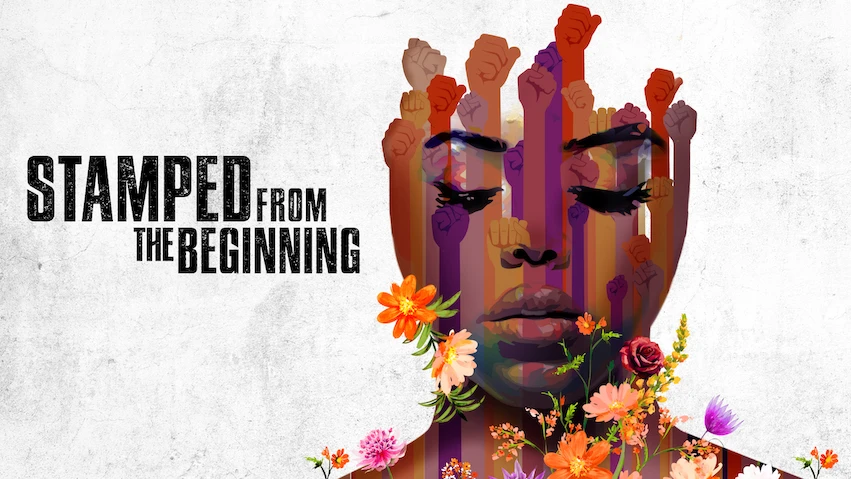
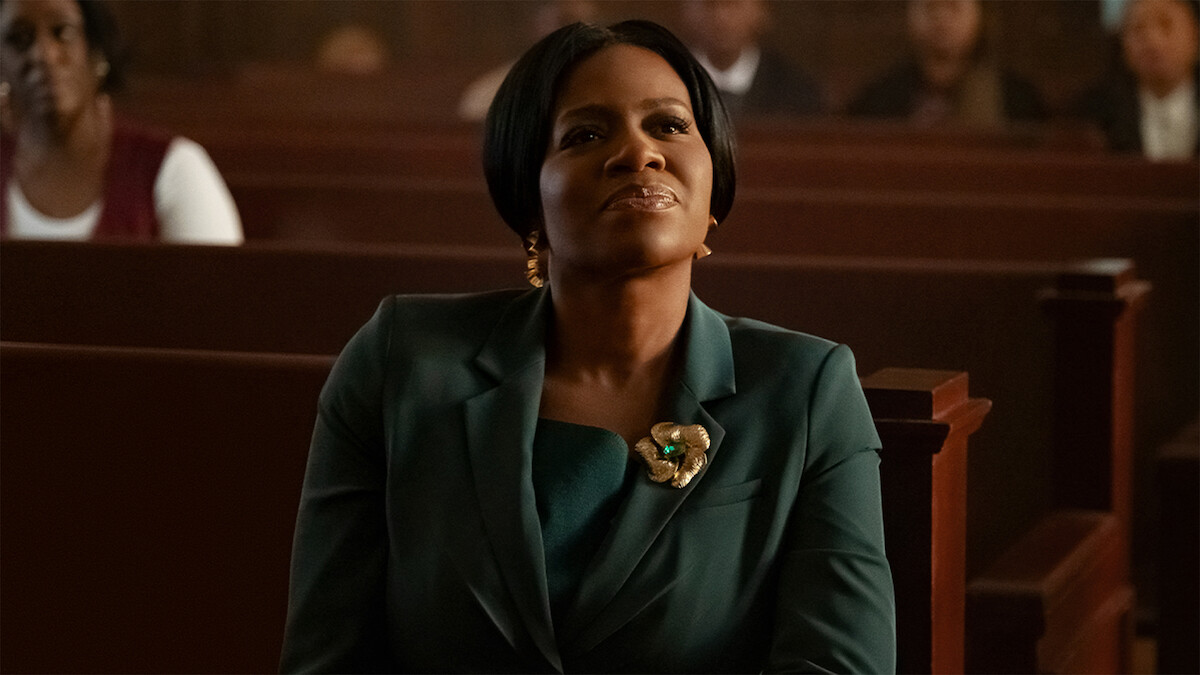
Stamped from the Beginning, the new documentary adapted from Dr. Ibram X. Kendi’s 2016 book of the same name, opens with a provocative question: “What is wrong with Black people?” A palpable discomfort can be felt as the puzzled commentators — among them historian Dr. Jennifer L. Morgan, Congresswoman Cori Bush, and sociologist Dr. Dorothy Roberts — consider the absurdity of the question.
As the documentary unfolds, however, it becomes clear that several such assertions have been made throughout history, only to be repeated and embedded into our collective consciousness, leading to the codification of these falsehoods through law and policy. “If we want to be fancy, we could call it ‘cultural narratives.’ I call it just straight-up lies that people tell themselves in order to justify the maintenance of these policies and inequalities,” Dr. Ruha Benjamin explains in the doc. Directed by Roger Ross Williams and executive produced by Dr. Kendi and Mara Brock Akil, Stamped from the Beginning does the work of unpacking the many myths that insist that something is inferior about Black people, a lie that harms American society. Here, we break down those myths and trace them back to the historical moments that birthed them.
The invention of Blackness
“Humans enslave each other — they have for as long as there have been empires and states and war,” says Dr. Morgan at the start of Stamped from the Beginning. For centuries before the transatlantic slave trade began, however, the majority of enslaved people throughout the Western European slave markets were of Eastern European descent. In 1444, the first large quantity of captive Africans were brought to Portugal to be traded and sold. “They were more valuable because it was harder for them to run away,” says Dr. Kendi in the doc. “It was harder for them to blend into the population.”
As Portugal’s Prince Henry increased the number of expeditions to West Africa in search of additional slaves, he enlisted the help of a chronicler named Gomes Eanes de Zurara to put a more positive spin on this brutal campaign. “Gomes Zurara justified [Prince Henry’s] slave trading by stating that [he] was doing it to save souls and that these people in Africa were inferior, were beast-like,” Dr. Kendi goes on. When Zurara’s book became a bestseller, the idea that people from Africa were less human than their European captors began to spread among Western enslavers. Zurara also flattened the various nations, tribes, and languages of Africa, asserting that their skin color was what united them as one people. “We came across that water and we were Fula, we were Igbo, we were Wolof, Yoruba, we were Mandinka,” says Honorée Fanonne Jeffers in the film. “But somewhere across the Atlantic, we became one community.”
The invention of whiteness
In the United States, enslaved people of African descent often worked alongside European indentured servants, which meant that they comprised a single underclass with shared common interests. In 1676, Bacon’s Rebellion demonstrated how dangerous this interracial solidarity could be, as thousands of Black and white people took up arms against Virginia’s ruling class. “That made it very clear to white landowners that they needed to invest more in separating indentured servants and enslaved people,” says Dr. Roberts in the doc. “They created a whole legal apparatus to give indentured servants privileges by the fact that they were white that Black people couldn’t have.”
This idea, that whiteness itself — regardless of country or culture of origin — is worthy of some greater reward than is deserved by people with darker skin, remains pervasive. “Whiteness keeps you from being at the bottom, even when you’re poor, even when you’re broke, even when you’re dispossessed,” says author Dr. Imani Perry in the film.
The myth of assimilation
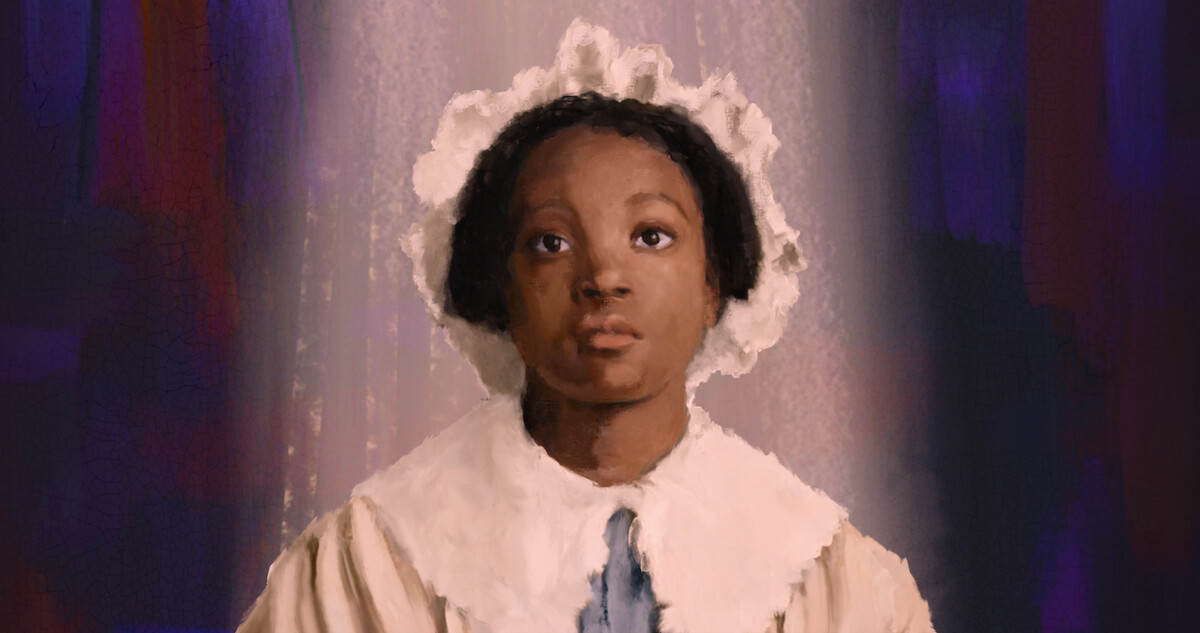
While this particular myth is often cloaked in the guise of progressivism, it’s in fact “another iteration of inferiority,” as Dr. Autumn Womack puts it. Assimilation purports that there is a “right” or “wrong” way to be and that this standard is set and upheld by white society. As for Black people, Womack says in the film, “There’s no value in what you have to offer — you either have to assimilate in this way or you have to create… a different infrastructure to account for your problematic presence.” In the 18th century, European and American philosophers argued that Black bodies were suited for physical labor, and white minds were suited for intellectual and artistic work. The documentary uses the example of Black poet Phillis Wheatley, who challenged this theory with her writing and had her brilliance called into question — a tribunal of prominent white men was convened in order to decide whether Wheatley was actually capable of producing her own work.
The myth of Black hypersexuality
“One of the most powerful myths about Black women that came out of the slavery era was the icon of the Black jezebel,” says Dr. Roberts in the doc. But the idea that Black women are innately promiscuous was created as a means of obscuring the sexual violence against them that occurred with impunity during slavery. “We have to understand that sexual violence was fundamental to the violence of slavery,” says Dr. Stephanie E. Jones-Rogers. The documentary zooms in on the complicated legacy of Thomas Jefferson, an enslaver who wrote publicly in opposition of both slavery and the abolition movement. While he wrote of his “great aversion” to the mixing of the races, he repeatedly raped Sally Hemings, an enslaved teenager who eventually give birth to six of his children.
During this time, Black women were considered “legally unrapeable,” says Dr. Kellie Carter Jackson. Adds Dr. Jones-Rogers in the film, “White men like Thomas Jefferson rationalized sexual violence perpetrated against Black women by saying that it wasn’t sexual violence at all.” While many were content to sweep these realities under the rug, Harriet Jacobs’ groundbreaking publication of her autobiography, Incidents in the Life of a Slave Girl, laid bare the truth of what slavery was like for countless Black women. The sexual harassment she endured at the hands of her enslaver led her to go into hiding for nearly seven years. “The dominant slave narrative in the United States was one that did not include women,” Dr. Carter Jackson says. “Harriet Jacobs was the first.”
The myth of the white savior
“The notion of the white savior is really a counterpart to white supremacy,” says Jeffers in the film. “If whiteness reigns supreme, if all the power rests with white people, then the power to save rests with white people.” A number of white abolitionists advocated for an end to slavery while still maintaining that Black people’s natural place was one of inferiority. Chief among these thinkers was Abraham Lincoln himself.
“Black abolitionists were the first abolitionists,” Dr. Carter Jackson explains in the doc. “They were the first to speak out about their grievances and about the evil of this institution.” The persistence of the white savior myth robs Black people, past and present, of their agency and does a disservice to their countless contributions and sacrifices.
The myth of the Black criminal
In the years following the Civil War, the rapid rate of Black progress throughout the South threatened the notion of inherent inferiority that had previously gone unchallenged. “White men saw Black men’s exercise of citizenship rights as a threat,” says Dr. Jones-Rogers in the film. “They immediately began to construct a very powerful mythology around the Black man who at all times has the ravishing and rape of white women on their minds.” This myth allowed racially targeted attacks to proliferate while maintaining a facade of righteousness. “[It] transforms racist violence into virtue,” explains Dr. Racquel Gates.
“The criminalization of Black people has been an essential part of white supremacy in America… a way for white people to explain why it’s important for a white power elite to control and contain Black communities,” Dr. Roberts explains in Stamped from the Beginning. In television, movies, political rhetoric, and news broadcasts, the link between Black people and criminality is reinforced over and over again. “These so-called innocuous ideas have the power to infect the minds of people who then use them and twist them to justify the massacre of Black people,” Dr. Jones-Rogers continues. From the national lynching epidemic that Ida B. Wells bravely reported on in the late 1800s to the Black Lives Matter protests that sprung up in response to the ongoing extrajudicial killing of Black people by police, as the doc shows, it’s clear that this pernicious myth endures.
The truth of an antiracist society
“The work that ought to have been done in the immediate aftermath of slavery — the work of reorganizing, retooling, reconceptualizing the entire society so that it might be possible for previously enslaved individuals to be free and equal — that work was never done,” says Dr. Angela Davis near the end of Stamped from the Beginning. As the film demonstrates, we have all been living with the repercussions of that failure to do so ever since. Any attempt to repair this damage must go further than simply acknowledging the reasons for its existence; there must be work done to actually rectify the inequalities that have been allowed to fester and harden over hundreds of years. While this may seem to be a daunting task, it’s worth remembering that it’s within our reach. “I know that it’s possible,” says Dr. Jones-Rogers in the doc. “Someone — some series of people — put the system together in the first place. And if they can put the system together in the first place, then we can undo the system.”
Watch Stamped from the Beginning on Netflix now.