Press Play
This ‘How to Change Your Mind’ Clip Shows People Taking LSD in the ’50s
It predates the counterculture movement by a decade.
July 15, 2022
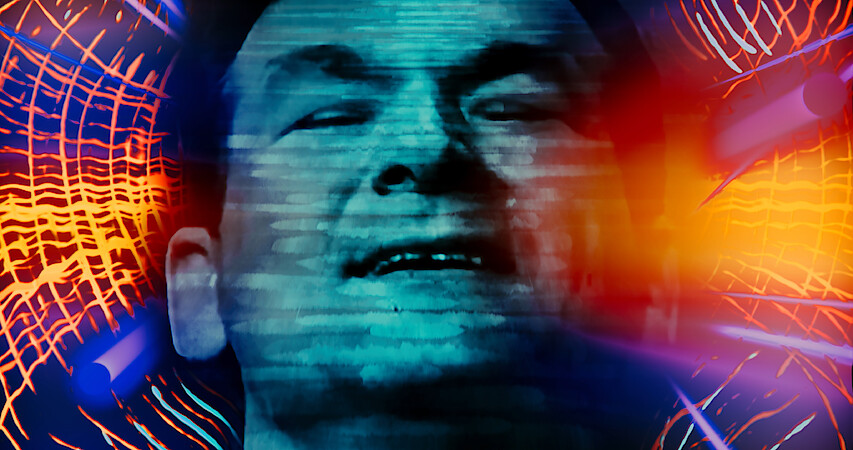
You probably have some idea of what tripping on psychedelics looks like: hippies in the late ’60s talking to the flowers, or a bad night comforting your college roommate as they have an existential crisis because they can’t find the head opening of their sweatshirt. But long before anyone was using LSD recreationally, the scientific community was studying its effect on human consciousness. This mind-bending clip from new documentary series How to Change Your Mind depicts lysergic acid diethylamide (LSD) use in a way you may have never imagined before: The subjects take a gentle dive into the subconscious mind, guided by psychotherapist researchers — all the way back in the 1950s.
The four-part docuseries How to Change Your Mind, executive-produced by Alex Gibney, is based on New York Times best-selling author Michael Pollan’s book, “How to Change Your Mind: What the New Science of Psychedelics Teaches Us About Consciousness, Dying, Addiction, Depression and Transcendence.” Gibney takes viewers on a journey to explore and unpack the potential that psychedelic substances like MDMA, mescaline, LSD and psilocybin (the chemical compound found in “magic mushrooms”) have to revolutionize medical science’s approach to mental health.
The clip appears in Episode 1 of How to Change Your Mind, which focuses on LSD. LSD was discovered in 1943 by Dr. Albert Hofmann, a Swiss chemist at Sandoz labs who was initially searching for a new drug to treat respiratory and circulatory ailments. Eventually, he distilled lysergic acid from the components of ergot, a fungus that grows on rye plants. While researching the compound, Hofmann accidentally dosed himself when he touched the liquid with his finger, resulting in what he described as a “wondrous experience.” The next day, Hofmann revisited his discovery, this time taking a much larger dose. Then he took a fateful bike ride home.
“Everything in my field of vision waved and distorted,” Hofmann says in the scene in How to Change Your Mind. “Riding home, my condition began to assume threatening forms. It was the feeling I’ve moved on to a different world, that this is the end. I’ve moved on to the other side.”
Hofmann was convinced he was losing his mind, but as the effects of the large dosage subsided, he reported feelings of euphoria, stating that it was “as if the world was newly created.”
Hofmann and Sandoz then knew for sure they had something radically powerful on their hands. By 1950, an open-source research and development program was underway, and Sandoz was distributing LSD to psychotherapists and researchers, including psychiatrist Humphry Osmond. Initially, Osmond and his peers referred to LSD as “psychotomimetics,” which meant that the drug mimicked the feeling of psychosis. However, when Osmond began experimenting with the drug himself, he realized that it actually felt too good to be labeled as such, and eventually he coined the term “psychedelic,” which, when translated from its Greek roots, means “mind-manifesting.”
This clip reveals some of the outcomes of Osmond’s guided therapy sessions with his patients, and the footage may surprise you. Contrary to fearmongering depictions of the dangers of reckless LSD use, this black-and-white footage shows a much gentler, profoundly beautiful experience for its subjects.
“I couldn’t possibly tell you,” says one of Osmond’s beaming patients after he asks her what she sees. “It’s here. Can’t you feel it? This whole room. I can feel the air and I can see it. I can see all the molecules. I’m part of it.”
Watch the trailer for the docuseries below.
How to Change Your Mind is available to stream on Netflix now.