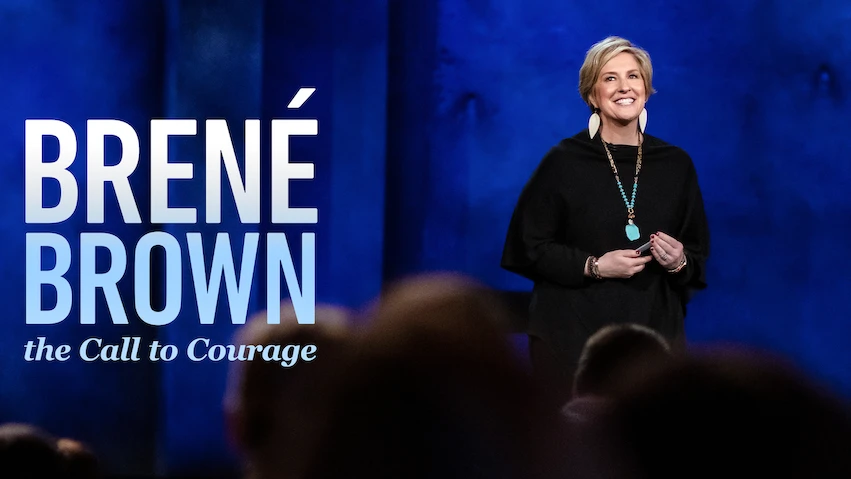
Brené Brown is back with a new book, Strong Ground: The Lessons of Daring Leadership, the Tenacity of Paradox, and the Wisdom of the Human Spirit, the second in her Dare to Lead series. Brown, a research professor at the University of Houston, rose to fame in 2010 after she delivered a TED Talk on the power of vulnerability. Since then, she’s published six New York Times bestsellers that focus on how embracing courage, vulnerability, shame, and empathy help build strong communities and companies — themes that she discusses in her Netflix special, Brené Brown: the Call to Courage.
In the 2019 special, Brown discusses her perspective around vulnerability and what it means to choose courage over comfort: “I’m not gonna bullshit you,” she says in the filmed talk. “Vulnerability is hard, and it’s scary, and it feels dangerous. But it’s not as hard, scary, or dangerous as getting to the end of our lives and having to ask ourselves, ‘What if I had shown up?’ ”
Her latest book, Strong Ground, builds on her foundational work to meet the moment we’re in now — one that’s plagued with reactionary politics and a struggling economy. “We need the courage to lead people in a way that honors and protects the wisdom of the human spirit,” Brown writes in Strong Ground. “Because, right now, we’re not especially good at what makes us human.”
A core part of that human spirit, as Brown showcases on an episode of Netflix’s Skip Intro podcast, is the ability to react with empathy and show courage through being vulnerable. In the episode, Skip Intro host Krista Smith discusses with Brown the concept of experiencing what the author calls “foreboding joy” (the idea that, when something good happens, something awful must follow), and how it can create a sense of shame in moments where we’d otherwise feel content.
“The need to dress rehearse tragedy in really joyful moments is more about vulnerability than shame,” Brown says on the podcast. “But having chronic and compulsive foreboding joy can be shaming. I can feel shame around how much I do that.” The conversation touches on how easy it is to imagine the worst — especially in a world of complete connectivity, where the 24/7 news cycle can make it feel as if we’re trapped in our own imaginary disaster reels. But Brown suggests that to lead with vulnerability is to create awareness around your choices: You can be fearful of the consequences of the joy you’re experiencing, or you can be grateful for it. Their Skip Intro discussion exemplified a core part of Brown’s work — tapping into your openness to guide you in moments when you need it most.